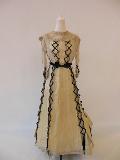

Skirt Description
The skirt is made up of two layers – a base (or underskirt) of tucked silk habotai with panes on top, latticed together in the same style as the bodice and an underskirt which is a rectangle made up of three panels that have been strategically tucked. All tucks stop about 10" above the hem to create fullness and flare between the lattice work.
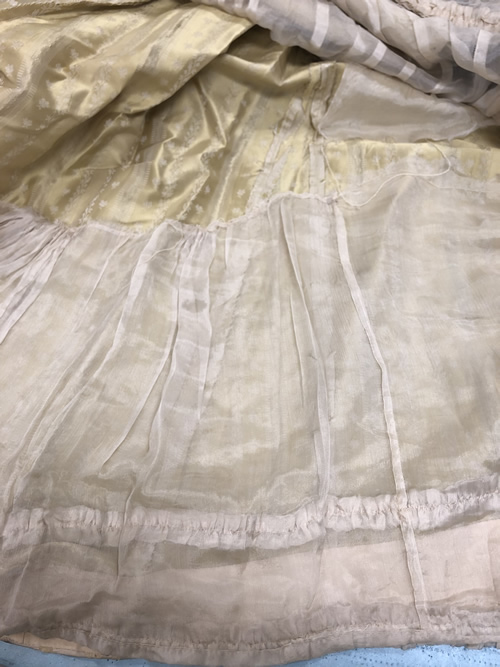
Figure 1: Dust Ruffle andUnderskirt Attachment |
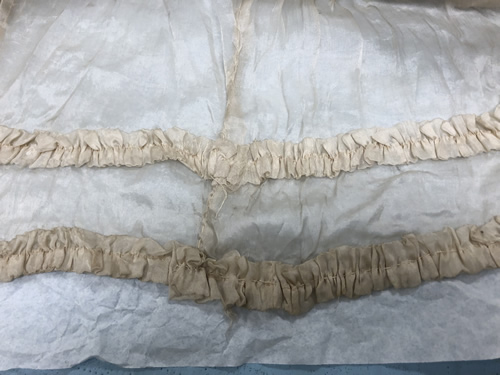
Figure 2: Hand-madeTrim on Underskirt |
 |
 |
The center front panel has 19 tucks of varying width. The tucks at the side front lattice measure 5/16th of an inch wide while the tucks at the center body measure 7/16th of an inch. This panel measures approximately 24.25" with tucks and is knife pleated into 10.25" at the waist band. The pleats, again, are done organically by the dress maker with most pleats falling towards the side seam. All pleats are varying widths, and the pleating is not done symmetrically side to side.
The back panels have 7 tucks each centered under the side back lattice. These tucks measure 5/16th of an inch. With the tucks taken, the back panel measures 15.5" and is eased into the waist over 7.25". The seams are sewn as a plain seam with a machine lockstitch and are selvedge edge, and thus have no additional finishing. This layer is tacked at the center back at the waist and left free down the length of the skirt. The bottom 15" of this layer are stitched to a dust ruffle (see Figure 1 above) and this portion of the seam is tacked to the side back seam of the overskirt. The ruffle is hand sewn to the back of the overskirt with a running stitch. The ruffle varies in length from 14.5 – 15.5". At the hem, the ruffle measures 82" and is gathered down to 37" at the top where it is stitched to the skirt. Most of the ruffle is finished at the top by turning under and stitching with a small running stitch, but some is left as a raw edge, possibly damaged from consistent wear.
The hem of the underskirt/ base layer is turned up twice and whip stitched by hand at about 1/4" wide. Two rows of trim are stitched to the bottom of this layer by hand with a running stitch (see Figure 2 above). This trim is handmade from a ruched tube of silk habotai measuring 1" wide. The seam in this tube was stitched entirely by hand before being gathered. The first row of trim sits directly on the hem, the next row is stitched 3.5" up from the hem.
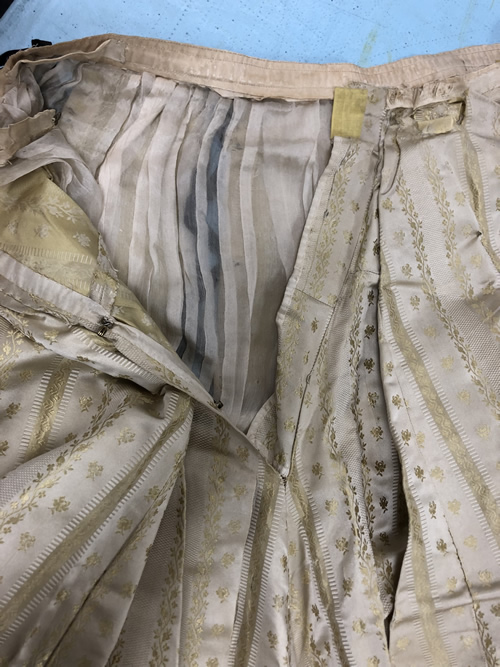
The back of the overskirt (fashion layer) is constructed of four pieces total. The side back piece is cut on the straight of grain at the side seam, and bias to the side back seam. The back piece is cut straight at the side back, and bias at the center back. This layer is constructed of one single layer of silk brocade. There is piecing throughout the back skirt, indicating it was re-made or that the fabric was very narrow in width (see pattern for detailed locations). The piecing is well pattern matched and hard to spot in most places. There is one deep box pleat at the center back, which measures 3”. The pleat closes over a placket attached to the right side of center back that measures 10.25" long by 1.5" wide (see Figure 3 below). The edges of the placket are bound with a 1/2" piece of silk tape.
Figure 3: Skirt Back Placket |
 |
All seams in the skirt are done with a machine lockstitch. The seam allowances have been crudely cut and finished with a hand overcast that is inconsistent in spacing and appears a bit messy. This further supports the theory that a home sewer took on the alterations of an existing gown. The hem circumference of the back panel is 80" and it has a small train. This portion of the skirt is hemmed with a wide (2") piece of bias taffeta whip stitched at top and bottom by hand.
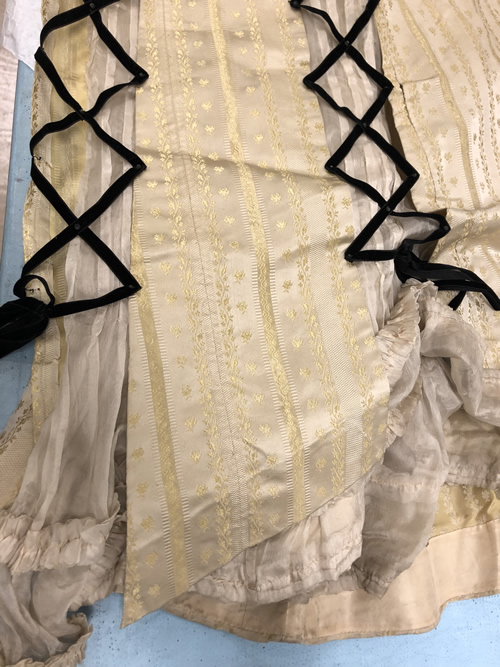
The side front panes have a small .25" dart over the hip that is 3.25" long and stitched by hand. This pane is cut straight of grain at the side front and bias at the side seam. At the hem, the piece comes to a dramatic point at the back ( see Figure 4 below). There is some piecing towards the side seam in this area even though the piece itself is rather narrow.
Figure 4: Side Front Panes |
 |
The center front panel is cut on the fold with the straight of grain running down the center. There is some piecing towards the side seam and it is hemmed on a curve with the front of the skirt panel dipping about 1.5" lower than the sides. The underskirt layer is 3.5" longer than the brocade overskirt – just enough to show both rows of stitched trim.
The lattice work is constructed in the same manner as the lattice on the bodice with mitered corners and sequin/bead placement. The trim on the skirt is wider and measures about 3/8". The lattice finishes 5” above the center pane and 7" above the side front pane and is tied into a neat bow with tails hanging to the hem. The seam allowances on the skirt panes are not finished -- they are only turned back and whipped down with a large whip stitch. In the same manner as the overcasting on the internal seams, the stitching is messy and inconsistent in width and spacing. The hem is turned up 2" on the side front panes and whipped down, while the center front is turned up with a 3" wide piece of bias taffeta.
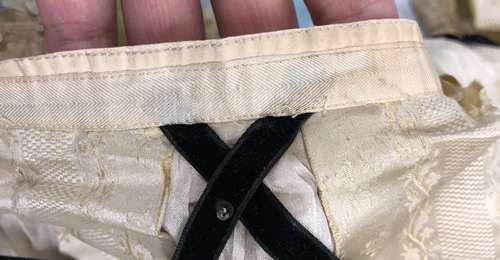
Figure 5: Waist Band Exterior |
Figure 6: Waist Band InteriorAnd Hanging Tape |
 |
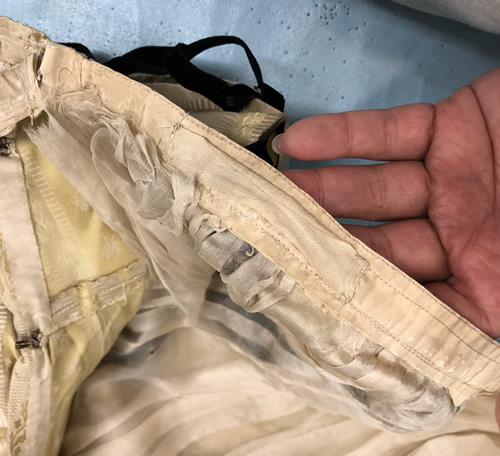 |
The waist band is two layers of straight-of-grain taffeta measuring 7/8" wide. The tape is folded at the bottom and machine lock stitched closed at the top. The underskirt layers are sandwiched between the taffeta waist band. The overskirt layers and velvet are topstitched to the outside of the band and covered over with a piece of silk twill weave tape. There are hang tapes stitched onto the waist on both side back panels. The tapes are constructed from the same twill weave tape that was used to cover the front waist band, indicating they were installed at the same time the skirt was made.
Figure 7: Center Back Closure |
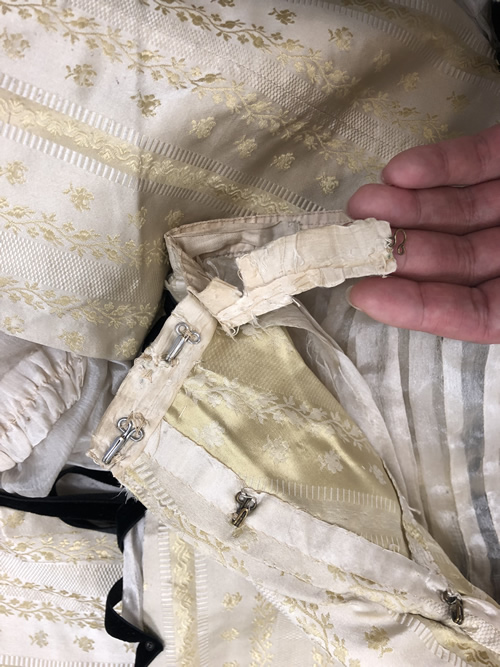 |
The center back closure on the skirt overlaps left over right. There are two hooks on the overlap that correspond to crochet thread loops on the placket. On the waist, there is an underlapping layer of the waist tape that corresponds to a hook on the inner right waist (See Figure 7). The skirt then overlaps on the waist and secures with two hooks and either bars or thread loops. No bars have survived and this area of the skirt is badly damaged. The stitching on the hooks is messy and is not consistent from hook to hook. It is possible these have been replaced or repaired over time.
Detailed Measurements of Original Skirt
Waist on skirt: 25”
Center front to hem: (bottom of waist) 38 1/2"
Side seam to hem: 39"
Center back to hem: 44 3/4"
Hem circumference (measured from the silk habotai and ruffle layer): 160"
© Alexandra Hagman, 2022