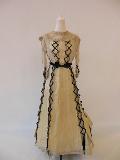

Pale Yellow and Cream Brocade Ensemble
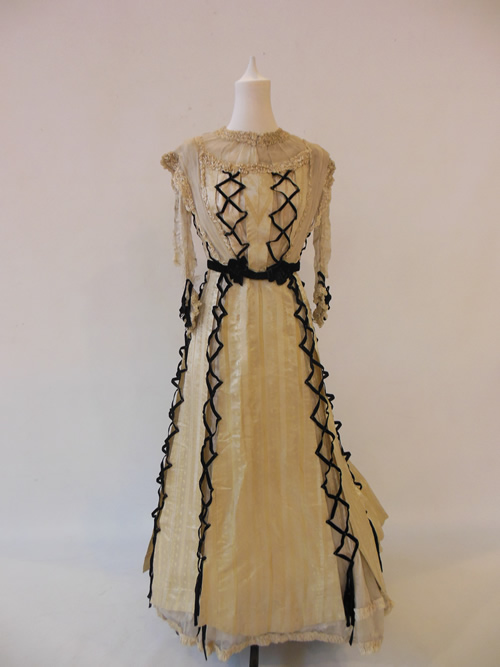
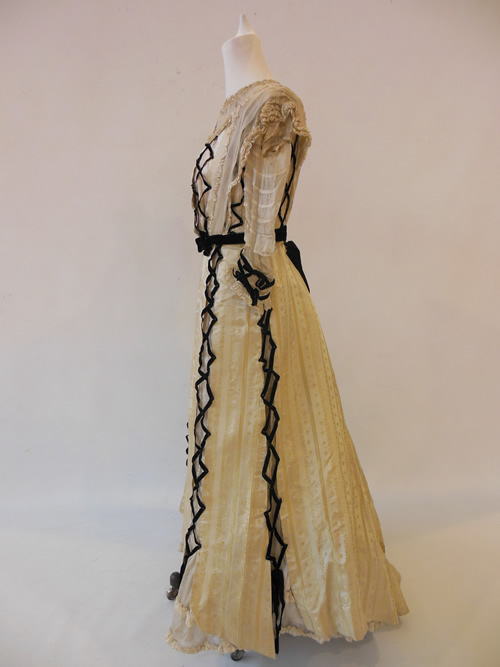
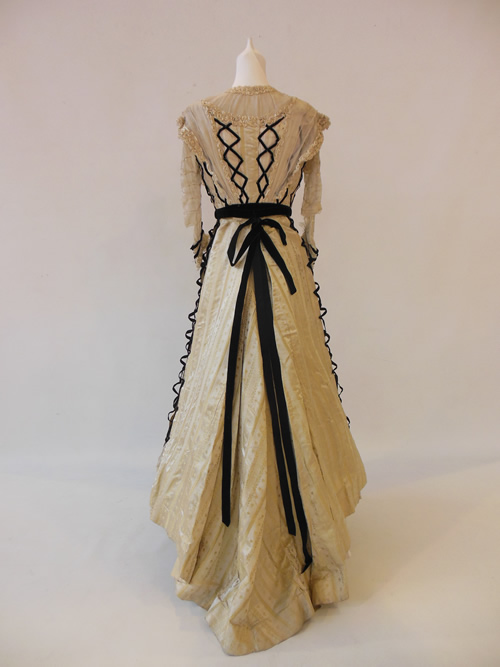
This ensemble is a day dress that likely dates c.1898-1903. The bodice and skirt are carefully trimmed, and the skirt is simply cut creating a relaxed yet feminine gown. I believe this ensemble has been created using an existing gown from an earlier time period. It seems likely that several women have worn this gown in one form or another as there is a significant amount of evidence pointing towards likely alterations and repairs to damage. Finishing techniques in the bodice indicate construction by a professional dressmaker from the gown’s first iteration. When the gown was reconstructed, it was most likely done by a talented home sewer as many of the finishing details have imperfections and some have been completed by hand where they could have been completed by machine.
Figure 1: Front |
Figure 2: Side |
Figure 3: Back |
 |
 |
 |
Description
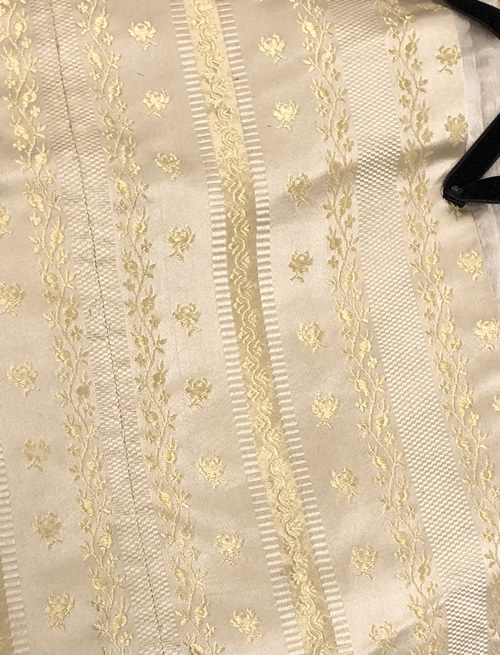
The gown is constructed almost entirely of silks. The interlinings are several different types of cream silk taffeta – some having tighter weaves with a heavier fiber and others much finer. The middle layers and sleeves are a cream-colored tucked silk habotai, and the shoulder flanges as well as the yoke are a very finely woven silk gauze. The outermost layer of the bodice and skirt are made of a medium weight silk brocade. It is pale yellow and cream in color. The brocade is woven with a lengthwise stripe containing a floral motif (see Figure 4 below). All trimmings are made of silks as well. The velvet ribbon has an extremely soft hand. It doesn’t have much opinion about where it folds and drapes, making it an excellent choice for the lattice work on the bodice and skirt. The shoulder flanges and neckline are decorated with a soft satin edged organza ribbon.
Figure 4: Brocade |
 |
Detailed Measurements of Original Garment
Center front to waist (bodice): 14 5/8"
Center back to waist: 13 3/4"
Neckline: 17 3/4"
Front neckline to shoulder seam: 3.5"
Front neckline to bottom of yoke: 3 3/4"
Armscye: 14.25"
Shoulder to shoulder front: 16"
Front yoke (armscye to armscye): 15"
Underarm to waist: 8"
Back neck to bottom of yoke: 4"
Back yoke (armscye to armscye): 14 1/4""
Shoulder to shoulder back: 15 1/2"
Waist measurement of bodice: 26"
Waist tape: 25"
Bust: 36"
Waist on skirt: 25”
Center front to hem: (bottom of waist) 38 1/2"
Side seam to hem: 39"
Center back to hem: 44 3/4"
Hem circumference (measured from the silk habotai and ruffle layer): 160"
Damage
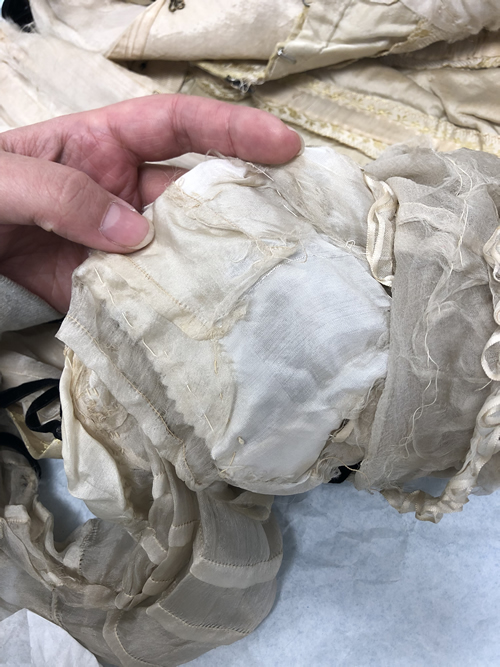
Figure 5: Left SleeveShoulder Repair |
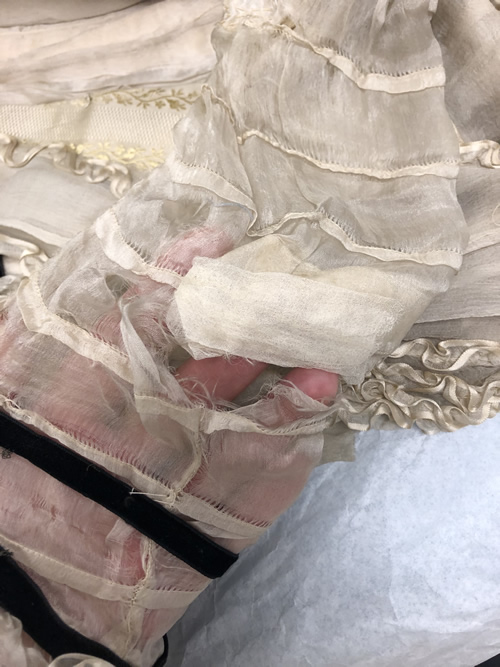
Figure 6: Right SleeveDamage |
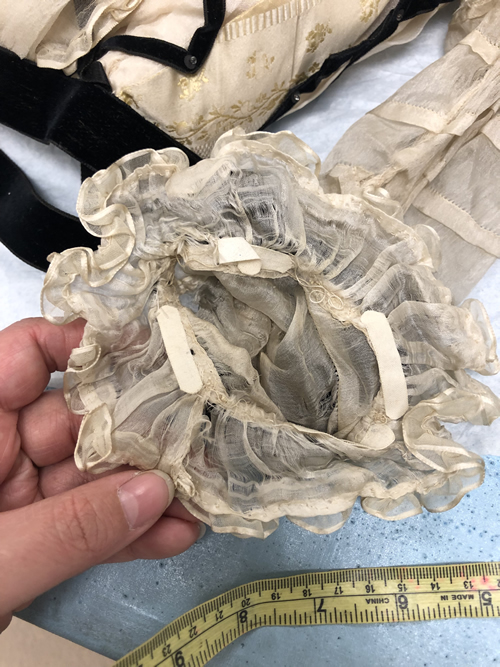
Figure 7: Right SleeveRepair |
 |
 |
 |
This garment is in fragile condition and must be handled with care. The sleeves have sustained the most damage and had the most repairs. Both sleeves are splitting where they were stitched with tucks as well as the front seam on the sleeve . The underarm area of both sleeves have separated almost completely from the armscye and the silk has deteriorated, likely from the presence of salts in sweat. Patches have been made on the underarm and shoulders with a lightweight silk taffeta (see Figure 5 above). The edges of these patches are pinked and sewn in with a 1/4" length running stitch around the damaged area. There is a patch on the right sleeve (see Figure 6 above) that has been adhered to the fabric. Initially I thought this must be a heat-fusible patch that could be purchased from a fabric store, but upon further inspection it became clear that the patch was pasted onto the fabric with an adhesive. The patch is made of the same lightweight taffeta that has been used to repair the shoulder. It is flexible but stiff and does not crack when bent.
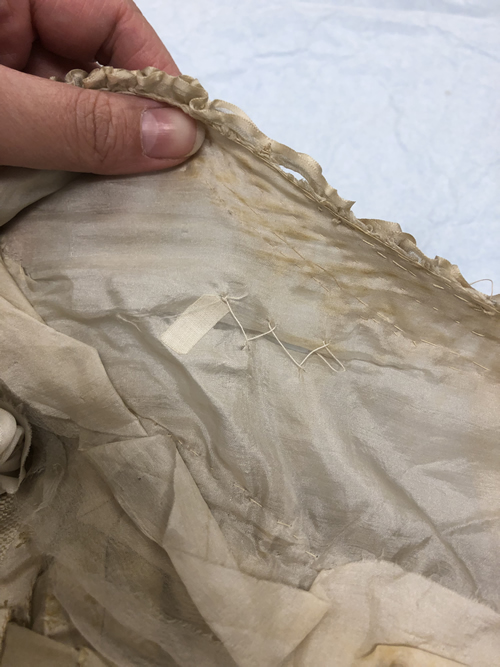
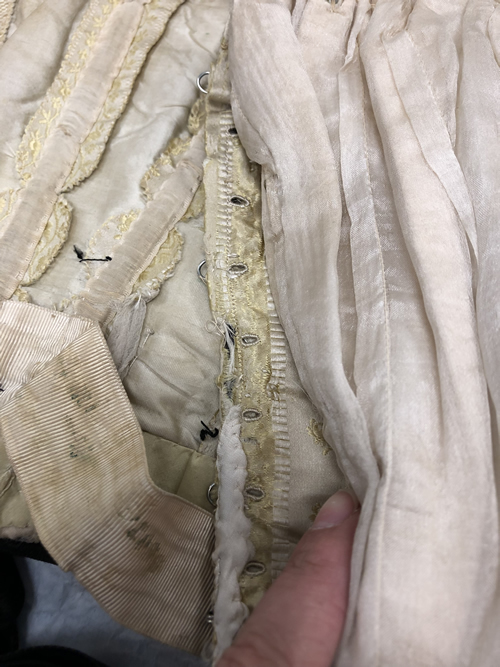
The hem of the sleeves has also been repaired in a similar manner, this time I believe with heat fusible patches that have been cut into small strips and pasted onto the sleeve (see Figure 7 above). The adhesive on these patches is weak and is peeling away from the fabric. Inside the bodice these strips were used to repair a portion of the silk habotai yoke base. The strip is pressed between the layers of habotai and gauze, pasted, and then a cross stitch was done loosely over the tear in the yoke (see Figure 8 below). On the front bodice, another repair has been made to conceal an opened boning channel. This repair was made with a not so neatly cut scrap of fabric with raw edges turned under. The edges are whip stitched all around. The patch is almost completely concealed by the middle layer on the bodice (see Figure 9 below).
Figure 8: Back Right Yoke |
Figure 9: Center FrontLeft Side |
 |
 |
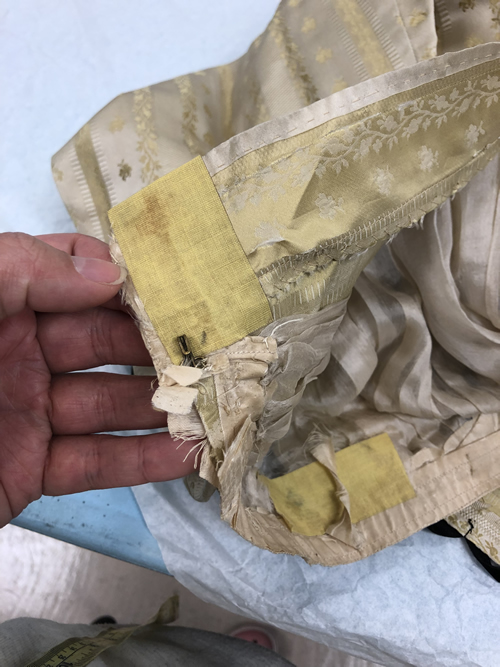
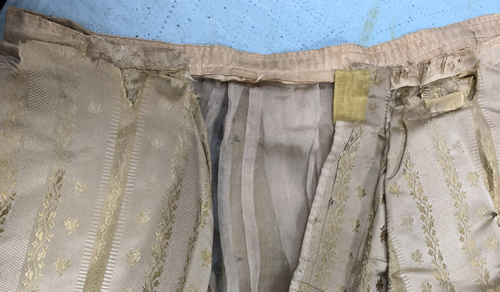
On the skirt, the back closure is the most damaged because this area takes the most stress when being worn. The skirt back near the waist has patches made of a yellowed cotton or linen ( see Figure 10 below). I believe these patches were heat fused to the garment. They are cut straight of grain patches with no finishing on the edges. They are well fused and the weave does not ravel. The patches are stiff but flexible and do not crack when bent. The fabric just under the waistband at the center back has fractured and pulled out from the waistband completely (Figure 11). No repair has been made to this damage. I believe that the bodice hooked onto the skirt in this area, and over time the stress caused the fibers to break and pull out from the waist band. The fabric is also carrying a lot of weight at this point from the box pleat, the train, and the dust ruffle. There is also damage to the underskirt layer where the silk has torn on the grain. It has been repaired by cross stitching the silk to the overskirt.
Figure 10: Placket Repairs |
Figure 11: Back SkirtWaist Repairs |
 |
 |
Research and Provenance
This ensemble was donated to the Costar Collection by Linda Foat, a donation that was processed from 2020 to 2021. Unfortunately, it was not possible to contact the donor to ask about this gown. The label on the waist tape inside the bodice clearly reads that the original gown was made by a professional dressmaker in New York City. Neither of my guesses at an address are searchable, but the neighboring buildings are 135 W. 79th Street was built in 1914, and the building at 137 W. 19th Street was built in 1910. I believe the original building that was at the address on the label has since been torn down and reconstructed, as the silhouette of the gown dates prior to both those dates.
I believe this gown as it is today was constructed (or rather, reconstructed) between 1898 and 1903. Late in the 1890s, stripes became a fashionable choice for dresses and the neckline became a widened square, according to several sources including J.A. Black and Madge Garland in their 1975 book, A History of Fashion. Without the yoke, the base neckline of this gown is a square.
This gown has a soft s-bend however the front bodice actually fits rather tightly and does not blouse as much as one might expect from a gown dating as late as 1905. In Janet Arnold’s Patterns of Fashions 2, there are two gowns that are strikingly similar in silhouette. The first, dated 1898 (Page 48 from the Gallery of English Costume) shares a similar shoulder silhouette and skirt silhouette with the pale yellow gown. The waistline and profile silhouette are nearly the same with the exception of the small point on the black velvet waist band on the yellow gown. The second gown, dated 1901-1902 (Page 50 from The London Museum) has similar sleeves and a similar neckline (excepting the yoke). However, the skirt is much fuller than the yellow gown and has a much more dramatic train. I believe that by using these two gowns as reference, it is safe to date the yellow gown c.1898-1903.
© Alexandra Hagman, 2022