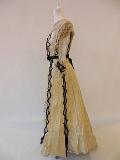
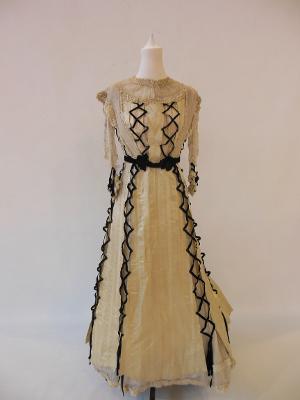
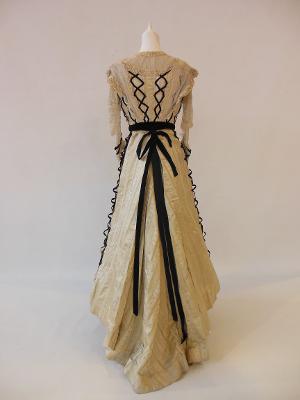
Construction: The bodice has a fitted inner bodice made of cream taffeta. There are 11 baleen bones in cream grosgrain casings. The two bones on each side of center front are very narrow, about 1/8" wide. The inner bodice closes at center front with 9 alternating hooks and eyes. There is an inner grosgrain ribbon waistband, which has two hooks pointing down on either side of center back. The inner bodice is hemmed with a facing of pale yellow taffeta. There is an outer bodice of cream China silk, with vertical 1/4" spaced tucks, laid over cream taffeta. Over top of the China silk are panes of pale yellow and cream silk brocade. The panes are connected with a lattice of black silk velvet ribbons (1/4" wide), which are decorated at each vertex with a black sequin and a clear seed bead. The yoke portion of the bodice is cream chiffon lined with cream China silk. There may have been some type of collar worn inside the neckline. The chiffon yoke is bordered by ruched ribbons with satin edges. There are pleated cream chiffon flanges running from the side front waist, over the shoulder, and down to the side back waist. The outer bodice closes with a few hooks and eyes, and one row of black velvet lattice has a tiny hook on each point which closes onto a thread eye on a proper left side front brocade pane. The bottom ruched trim along the yoke also closes on the proper left side with a hook and bar hidden underneath the chiffon flange. The sleeves are made of one layer of cream China silk, with horizontal 1/4" spaced tucks. The sleeve hems are decorated with the ruched trim and black velvet ribbons (3/8" wide). The bodice waist has a 1" wide black velvet ribbon belt with two bows on each side of the center front waist. There is a long length of the same ribbon attached to the center back waist, but the bow has come undone.
Construction
The skirt has a cream China silk layer that has vertical tucks ranging from 1/4" to 1/2" wide. The tucks are released about 8" from the hem. The hem of the China silk layer has two rows of self-fabric shirred ruffles, one right at the hem and one 2" above that. The overskirt is made of wide panes of the pale yellow brocade connected with 3/8" wide black velvet ribbon lattice. These ribbons have the same sequin and bead decoration as the bodice. There is a center front brocade panel, 2 side front panels, and 2 back panels. The back panels are deeply pleated at center back. There is a placket at center back with three hooks and thread bars. The waistband closes with three hooks and eyes. The back panels of the brocade form a train, so those panels have taffeta hem facings. The front brocade panels are not as long as the China silk layer, so those panels have the hems just turned up and stitched. The center front measures about 37" long, whereas the back measures about 44" long.
Provenance: On the waist tape there is evidence of a dressmaker's stamp but only small bits of greenish pigment remain. It appears to have a brand (or dressmaker's name) that is not very distinguishable. There is also an address stamped below the name, which appears to read either 136 W. 79th St N.Y. or 136 W. 19th St N.Y. The gown was given to the Costar Archive by Linda Foat donation in 2020-2021.
Damage: The sleeves are in the worst shape because this China silk is fragile and coming apart in places. There are some patches that indicate repairs and/or a possible lining that is mostly missing now. The sleeve hems also have some iron-on mending tape applied to the inside which makes it look as if it was worn on stage. The skirt appears to have once had a cream taffeta lining, but only remnants remain at the top of the inside of the waistband. The skirt waistband also has iron-on mending tape applied.
Tags: Has been studied and reproduced by MFA candidate