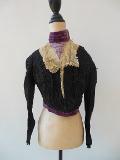

Black Beaded and Lace Bodice ca. 1898-1903
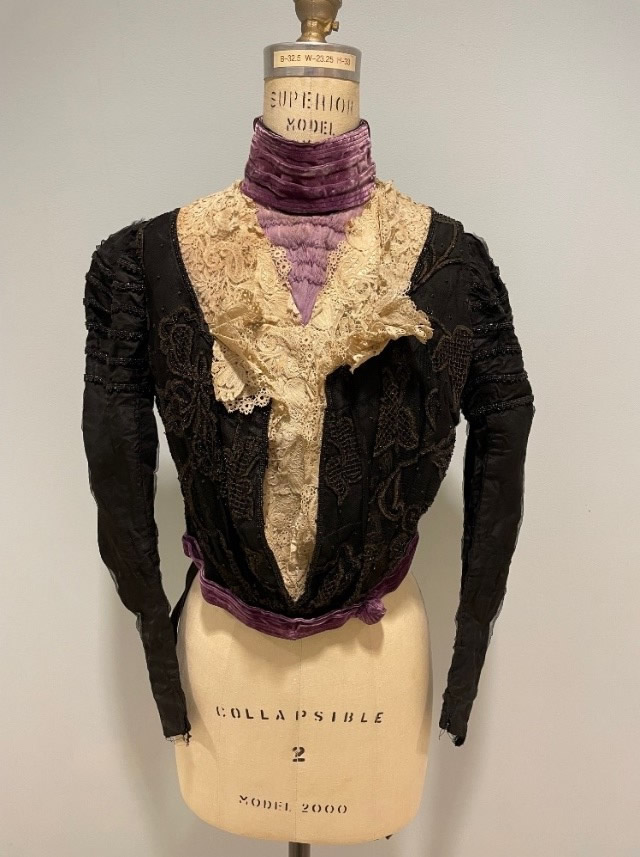
Figure 1: Front |
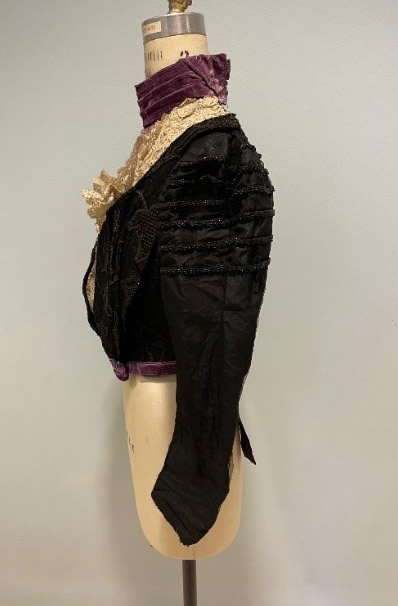
Figure 2: Side |
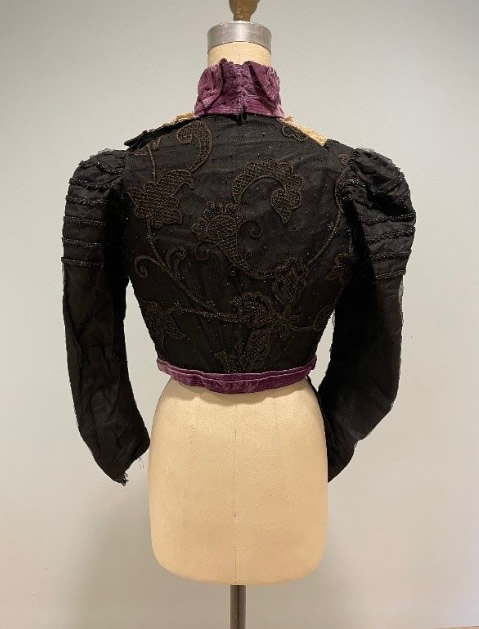
Figure 3: Back |
 |
 |
 |
This women’s bodice from ca. 1898-1903 was made in Chicago, Illinois, USA. It features a long-waisted pigeon breast silhouette, fitted back, long fitted sleeves with a slight shoulder puff, and a high stiff collar. It is black with jet beaded mesh on the torso and is ornately decorated with jet beaded trim, purple velvet, purple chiffon, and handmade off-white lace.
Dating
At the end of the first decade of the 20th century, separates fell out of fashion and one-piece dresses became more common. Phyllis G. Tortora and Keith Eubank remark about the end of the nineteenth century on page 397 of their book A Survey of Historic Costume that, "Two-piece dresses were constructed with lined and boned bodices that usually ended at the waist and had round or slightly pointed waistlines." On page 425 they say of the Edwardian period, "Dresses were generally one piece, with bodices and skirts sewn together at the waistline." Scalloped and bound seam allowances with encased bones were also common for bodices of this era.
The silhouette of the bodice straddles the late 1890's and early 1900's. On page 229 in The Cut of Women's Clothes, Norah Waugh says, " ... by 1898, though the back of the bodice fitted closely, the front fullness became softer and looser and began to pouch over the waistline. The front of this bodice was cut on the straight, waist length at the sides, but dipping towards the center several inches below waist level. The resulting fullness was gathered or pleated on to the fitted lining…" Due to compression over time the powder (or pouter) pigeon effect of this bodice is diminished, but one can surmise its existence by the gathered taffeta in the plastron. This bodice dips ever so slightly below the waist in the front, as can be seen above in Figure 2, again signaling the short transitionary period to the Edwardian s-curve. Additionally, the lavish decorations on this bodice, which can be seen in Figure 1 above, were popular at the beginning of the twentieth century, included in decorations such as “... yokes, berthas, simulated vests, or lace ruffles ...” according to Lucy Barton on page 548 of Historic Costume for the Stage.
Puff sleeves shrunk from their biggest occurrence to a rather fitted sleeve cap in a matter of a few years at the turn of the century. According to Tortora and Eubank on page 397, "After 1897 sleeve size generally decreased and reminders of the larger sleeve styles could be seen in small puffs or epaulettes at the shoulder, the rest of the sleeve being fitted." This bodice marks the transition, having a modest puff, following the curve of the arm and being tight around the wrist.
Collars of the 1890's were stiff and tall, and often decorated in trims such as velvet. The turn of the twentieth century saw more lingerie dresses, so collars were still high but were usually made of lace stiffened with bones. This collar resembles the earlier style.
Construction
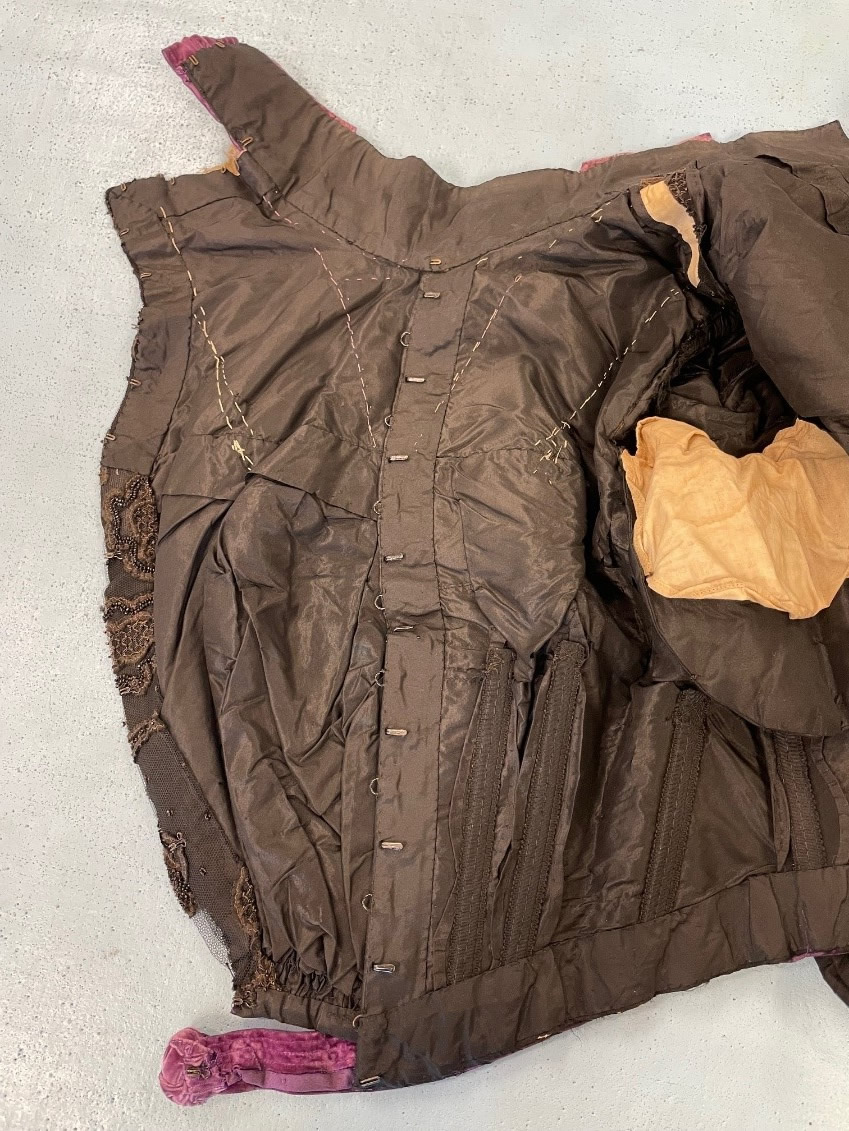
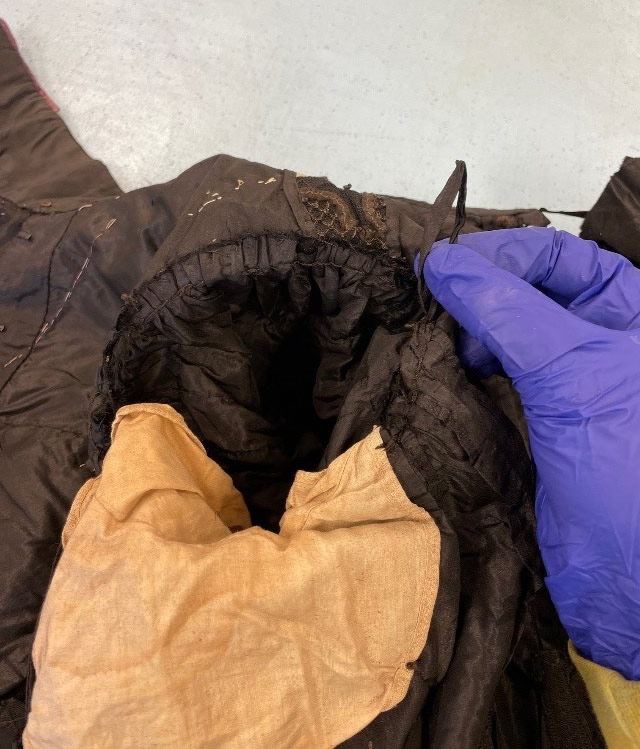
There is a center front closure on the inner bodice, which fits closely to the corseted body. A decorative plastron covers the inner bodice. The plastron closes over the front and creates a highly decorated illusion obscuring the closure and emphasizing the pigeon-breasted shaping. The plastron is attached to the yoke of the interior and side front and fastens to the left side. It fastens to the center back collar, shoulder seam, down the front armscye, and down side front with hooks and thread bars. Then an extension of the velvet belt hooks onto the left side at the waist completing the illusion. The collar is attached to the plastron and closes at center back with hooks and eyes, as can be seen below in Figure 4.
Figure 4: Inside Front |
Figure 5: Inside Back |
 |
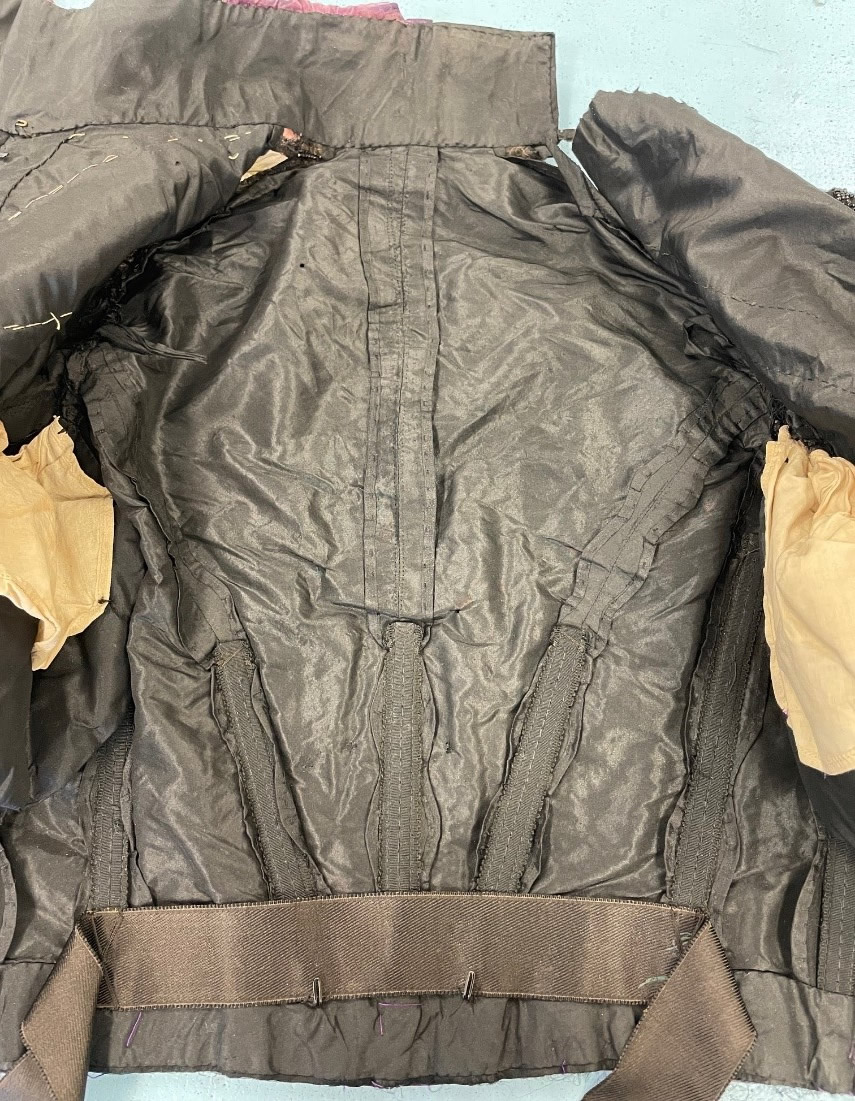 |
The interior is entirely of black silk taffeta. It consists of one front piece and three back pieces. The center front is not straight, as it conforms to the curve of the body, and thus has two horizontal bust darts. The center front closes with alternating hooks and eyes spaced about 1" apart. Only the interior is boned, not the plastron covering. The bones are probably constructed of feather spines grouped together and bound to each other, based on looking at the top edge of the bone and comparing it to an existing feather bone. This might have allowed the stitcher to sew through the bones to attach them to the bodice, as evidenced by a line of stitching down the center of the encased bones. Seam allowances on the interior have been scalloped and bound by hand with taffeta selvedges (see Figure 5 above).
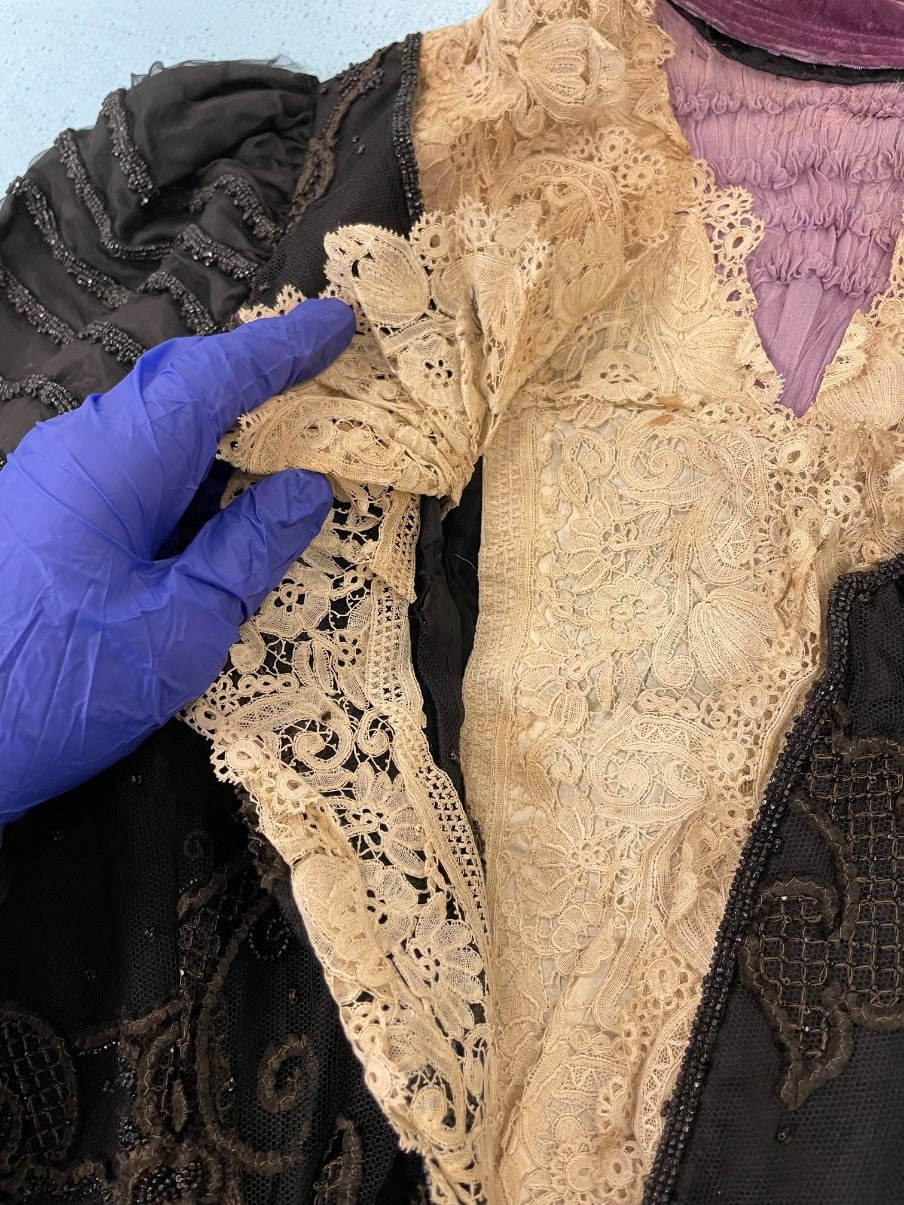
The plastron consists of a base layer of taffeta. It has a yoke, which keeps it flat above the muscle point. It is gathered below that point which creates the powder (or pouter) pigeon silhouette. A triangle of purple silk chiffon with gathered tucks decorates the center of the yoke. To the sides of this piece, there is a layer of white taffeta which extends the full length of the bodice to create a light-colored background for the lace. It is slip-stitched onto the yoke (and the white stitches can be seen on the inside). The first layer on top of the lower section is black silk chiffon, which is never seen. There is a flat layer of off-white lace stitched to the white taffeta. The outer layer of the plastron is a separate piece, like a false vest, which has an asymmetrical pattern. Another layer of off-white lace is attached to the inside of this layer with pleats at the corners. 1/4" beaded trim edges the outer "vest" layer which can be seen in Figure 6 below.
Figure 6: Lace Stitched to False Vest |
 |
The garment has an over layer of black silk chiffon, then beaded silk (or cotton) net. The pattern of the beading is asymmetrical on front, as can be seen in Figures 1 and 3 above. The beaded net wraps as one piece across the back and under the plastron, and is hand-stitched flat to the bodice foundation through the mid-shoulder to waist. On the side where the plastron is attached, the beaded edge of the plastron is turned under and stitched.
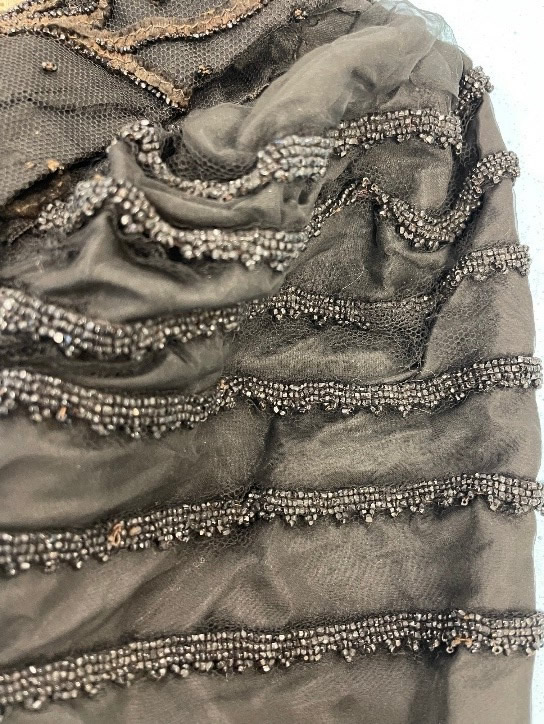
The sleeves are gathered at the top and taper to a tight wrist, with small darts at the elbow to take on the bend of the arm. The wrist is narrow and has a 1" opening at the bottom of the seam which is closed with a hook and eye. The inner layer of the two piece sleeve is cut from the black taffeta, but the chiffon layer on top of it is cut in one piece. There are six rows of 1/2" wide beaded trim which go all the way around the arm horizontally, starting about 2" down from the top of the sleeve 1" apart. It appears that there was a layer of net on the sleeves, but it has since disintegrated almost fully. It is unknown whether this was also beaded. There is also a scant amount left of 1/2" wide gathered net at the base of the wrist.
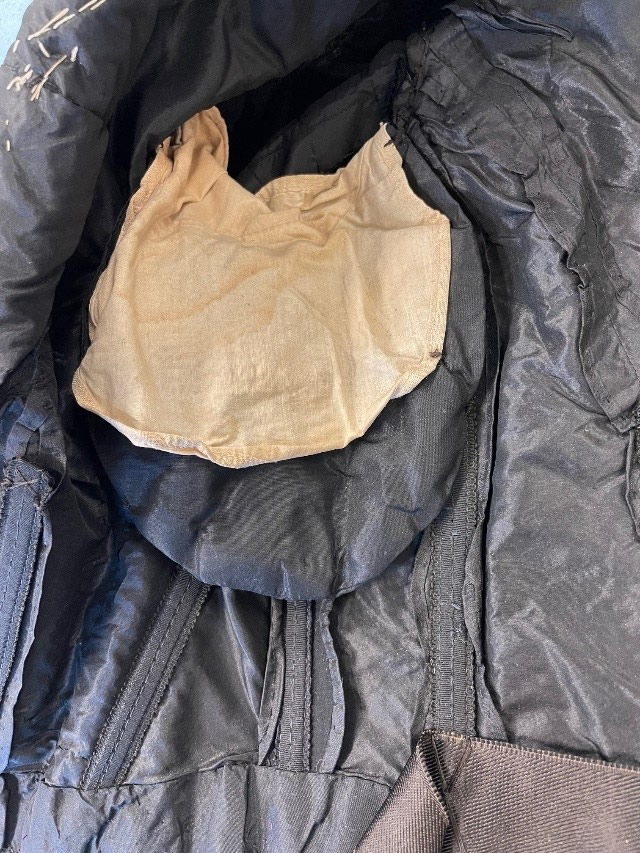
The sleeves were set in by hand with a backstitch, and finished with a whipstitch. There is a separate pad placed in the side front to augment the wearer for a fashionable silhouette (see Figure 7 below). It is a circular taffeta case filled with wool or cotton. Natural colored cotton pit pads cover the shaping pads to protect the garment from sweat, but they show little signs of damage. There are hanging loops stitched into the armsceye, as can be seen in Figure 8 below.
Figure 7: Pads for Shaping
|
Figure 8: Armhole and
|
 |
 |
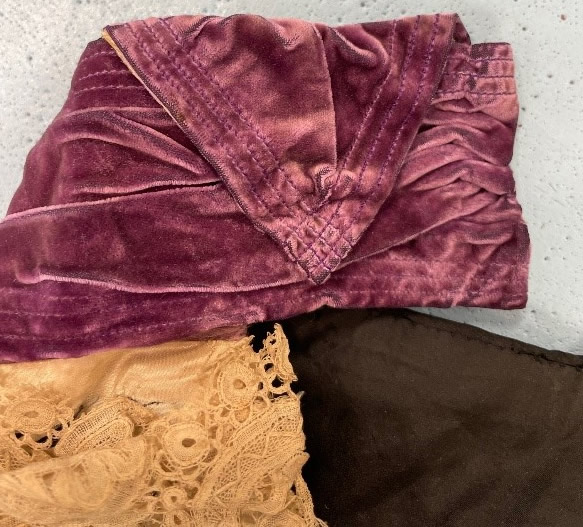
The collar is probably stiffened with canvas and does not contain any bones. The base is covered with black taffeta on the outside and lined with the same. It is layered with a piece of bias purple velvet which is pleated horizontally and top-stitched on the edges. Two triangular flaps of the velvet, top-stitched and finished with white taffeta on the underside, sit on either side of center back (see Figure 9 below). The underlap of the collar is left plain, without velvet, to reduce bulk. The velvet is silk.
Figure 9: Left Back Collar |
 |
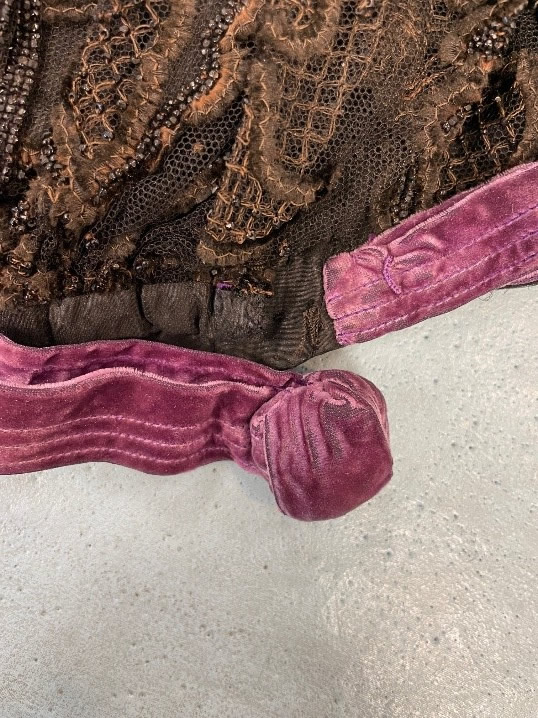
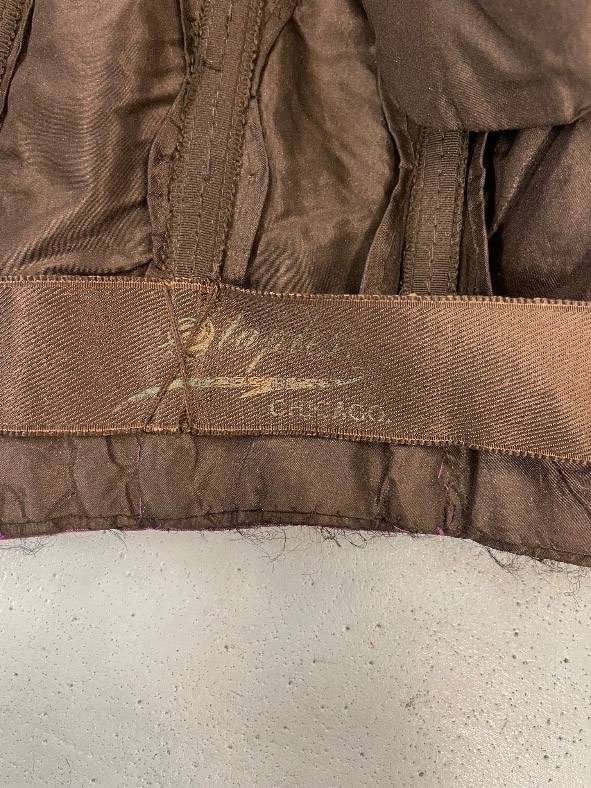
A strip of bias purple velvet is used as a belt at the waist. It is pleated once horizontally, top-stitched, and finished on the plastron overlap with a decorative ball, as seen in Figure 10 below. It does not appear there is anything inside the ball to stuff it, so the fabric may be tightly wound around itself. A hook fastens the belt to the waist.The waist edge and plastron edge are faced with a 1" wide strip of bias taffeta, put on entirely by hand. There is a fancy satin waist tape with the words “Staples Chicago.” printed on it, as can be seen in Figure 11 below. Additionally there are two skirt hooks 2" apart at center back.
Figure 10: Belt Overlap |
Figure 11: Waist Tape for
|
 |
 |
Condition
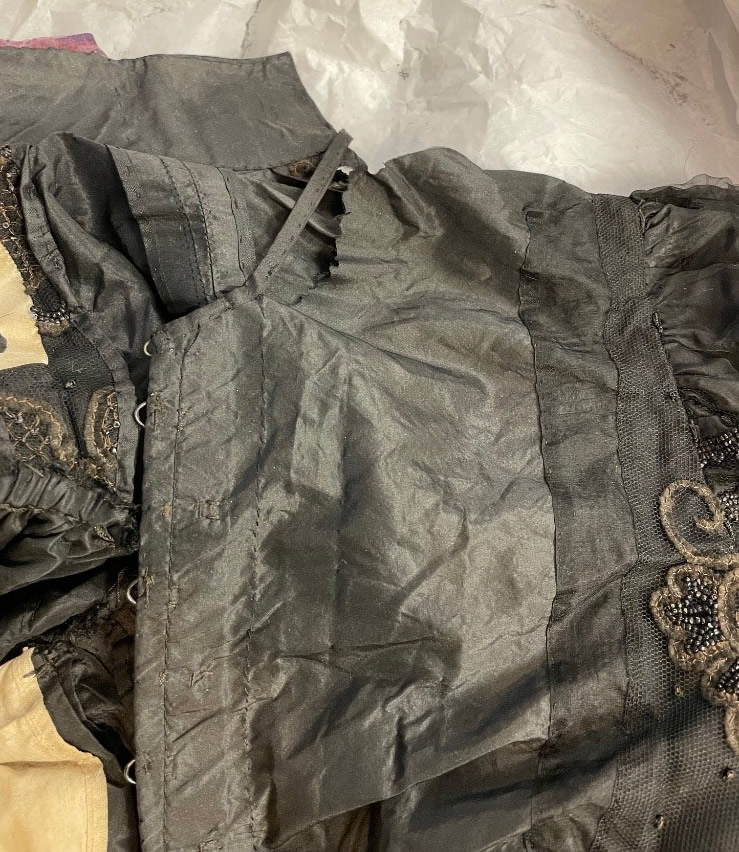
This bodice is extremely fragile, especially the softer fabrics. The base layer of taffeta is structurally unsound. The right neck edge has torn presumably due to the stress of the plastron (see Figure 12 below). The sleeves contain sparse remnants of cotton mesh which disintegrates when handled (see Figure 13 below). It is uncertain whether this is the same beaded mesh as covers the front and back. It is possible that this layer of mesh was originally included and then removed when it became fragile. A scant amount of 1/2" gathered mesh remains on the wrist edges. There are holes in the beaded layer around some of the thread bars. As mentioned above, the powder pigeon front is flattened from storage and some of the tacking between decorative layers has come apart. There do not appear to be many alterations to the bodice, save for the center back seam.
Figure 12: Neck Edge Damage |
Figure 13: Mesh Remnants |
 |
 |
The purple velvet has faded, and something closer to its original color can be seen on the inside of the pleats. The lilac chiffon has also faded in color. The brown flocking on the beaded mesh may also have faded from what would have been black originally.
Measurements of Original Bodice
Center front to waist: 16
Top of false vest to waist: 10
Center back to waist: 15
Neck: 15.5
Armsceye: 15
Shoulder to shoulder front:13.5
Front armsceye to armsceye: 15
Back armsceye to armsceye: 12
Shoulder to shoulder back:
Waist: 27
Bust: 36.5
Collar height: 2.5
Sleeve shoulder to wrist: 26
Wrist: 8
Elbow: 11
Width of velvet belt :1
Lace width: 3-4
Bones
Center front: 7.5
Side front darts: 7, 6.5
Side front: 5
Side seam: 6
Side side back: 7
Side back: 6
Center back: 6
© Matty Blatt, 2024