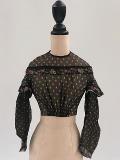

Dark Gray Silk Oval-printed Bodice, c.1854-1858
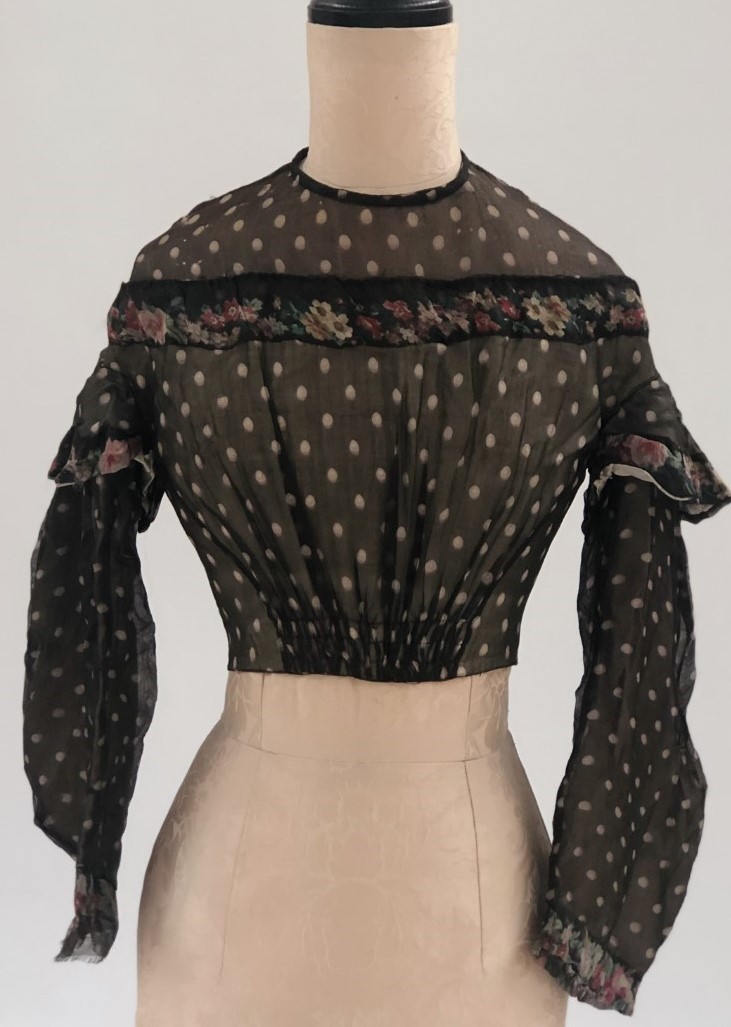
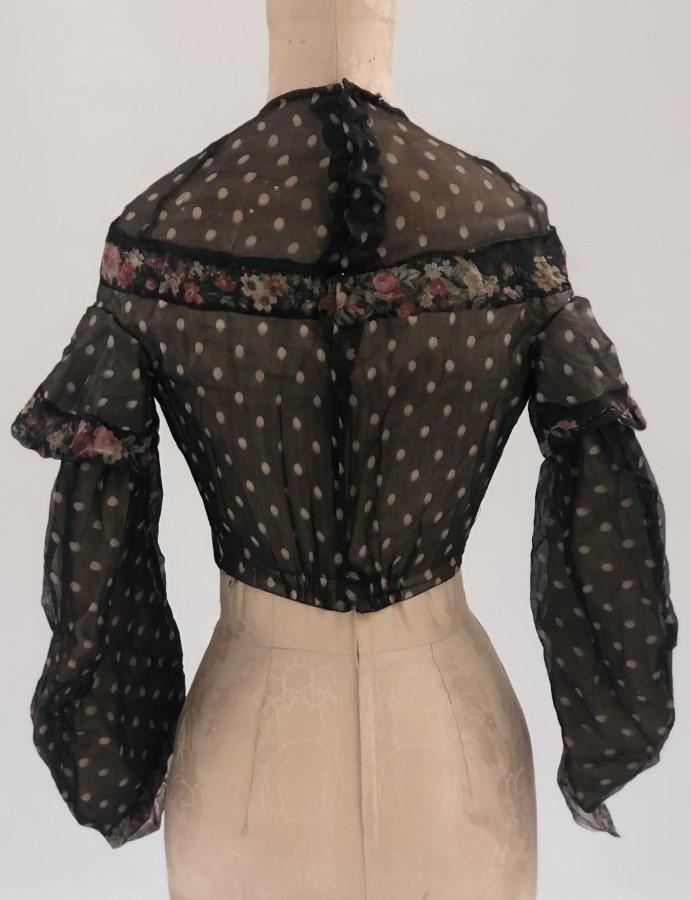
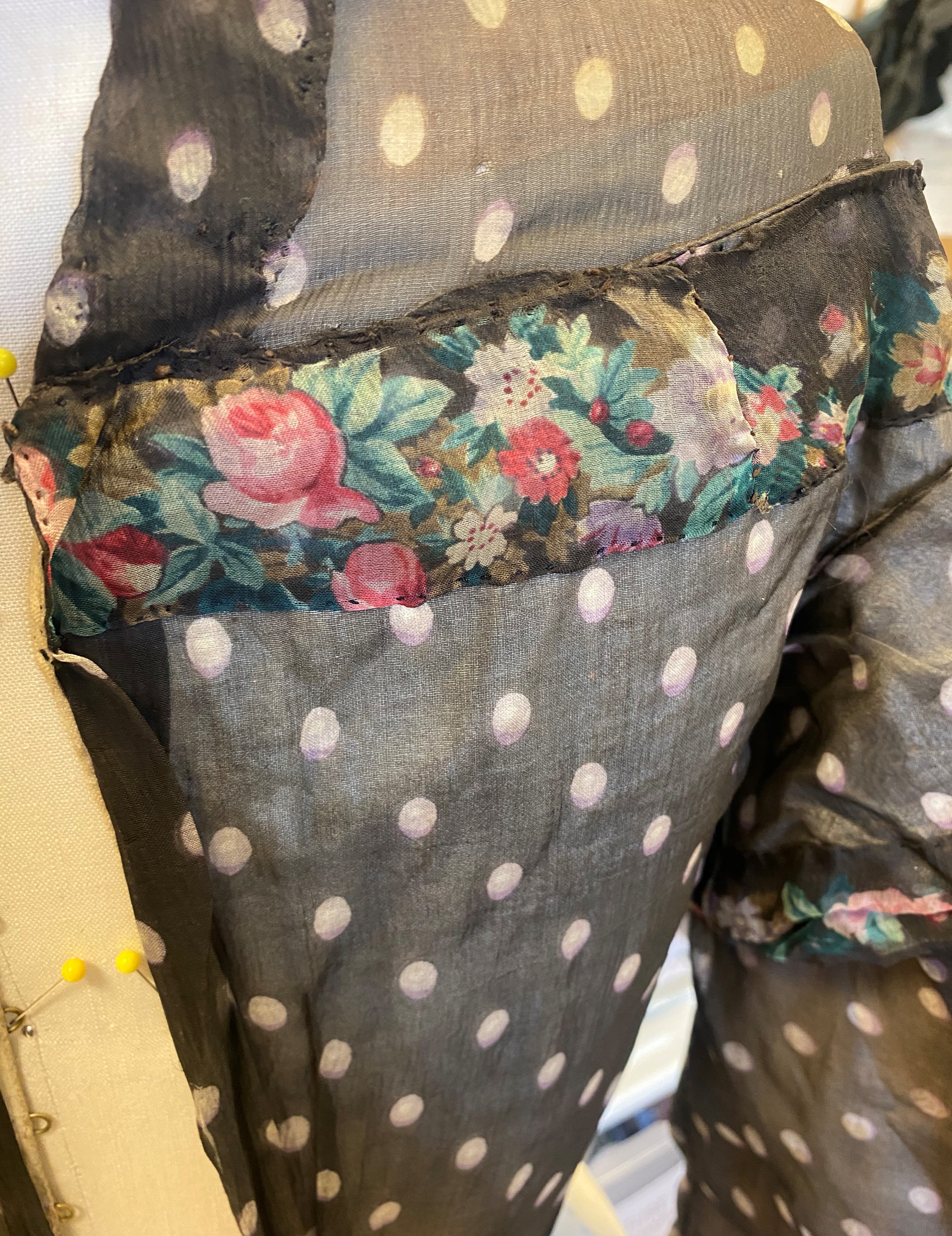
The c.1854-1858 young or small woman's bodice shown below in Figures 1 and 2, is constructed in two layers consisting of the sheer, gathered outer bodice and a boned coated linen inner bodice. The outer bodice is a lightly crinkled silk chiffon and is dark gray (possibly originally black), printed with white, lavender, and light mauve oval-shapes. The outer bodice has a slightly curved waistline and is gathered at center front and center back, onto the underbodice, with an unlined sheer yoke. The shoulder seams on the yoke are off set from the shoulder seams of the underbodice. At the top edge of the bodice front at the yoke is a surface-applied floral border that has fine thread piping at the yoke on the front and back of the bodice. The thread piping is also used as a finish in the armscye and on the bottom edge. The neckline is bound with the dark gray printed fabric. The bodice closes at center back, with six black hooks and eyes on the yoke with a 3/8" overlap with no closures on the silk below the yoke, which allows the outer layer to flounce at center back. There are eleven hooks and eyes at center back with a 1/2" overlap and a bone casing on the overlap side. The shoulders are sloped with long sleeves with a flange and no closures. The entire outer bodice and sleeves are hand sewn.
Figure 1: Bodice Front |
Figure 2: Bodice Back |
 |
 |
The under bodice is a coated linen in a yellow/tan color and is boned with baleen. There are six total darts: two vertical darts on each side of center front and one (on each side) horizontal dart originating at the outermost vertical dart to the side back seam. The vertical darts in the front of the bodice are used as bone casings, and the side back seams are used to encase bones. There is a piece of selvedge acting as bone casing at center front, and one at center back on the underlap side of the bodice. No bone is present at center back on the overlap side. The inner bodice is machine stitched, apart from repairs that have been made by hand. It is secured to the outer bodice with machine stitching at the front princess line and the side seams.
The sleeves have an inner and outer sleeve with the same shape. The inner sleeve is a fine, cotton and the outer sleeve is the printed silk. The outer sleeves are cut cross grain and are two pieces. The inner sleeves are two different patterns making the same shape. There is a 5 1/2" flange at the sleeve cap. The sleeves are similar to a Bishop sleeve and are full with no closures are the wrist.
Background
This historic bodice appears to have been constructed in its current shape in the early to middle 1850s, possibly between 1854 and 1858. This determination is based on the bodice construction methods, fabrics, shape, and available sewing advances of the time. There are no labels or identifying features found in the bodice. There have been alterations and repairs made to the bodice. These repairs and alterations could have been done later when a sewing machine was accessible by its owner.
This determination was based on multiple observations. First the height of the waistline, curved waistline, gathering at center front and center back, and the waist was finished with piping. The nape to waist measurement is 12" at center front and 16" at center back with a slight curve. It would likely sit at or above the natural waistline. In her book, The Cut of Women's Clothes, Norah Waugh suggests waistlines rose in the late 1840s becoming closer to the natural waist by the 1850s. The outer bodice was gathered at center front and center back over the darts that shape the under bodice. Both were cut on grain, with the darts and gathering creating the illusion of a small waist. There are no princess seams in either the outer or under bodice, which a was common construction method of this time. Several sources state that this was common including Norah Waugh who states that bodices could be fit by means of waist darts. This bodice has two almost vertical darts that end near the bust point, and one horizontal dart on each side of center front, helping to create an "ogee-shaped body" according to Norah Waugh on page 139 of The Cut of Women's Clothes. The horizontal dart helps to create the shaping and smoothing at the side of the body since there are no side seams. The side seam is shifted 1 1/2" towards to the back, creating a side back seam. Also, the shoulder seams of the under bodice are slightly shifted beyond the natural shoulder line. The neckline and shoulders are dramatically sloping. There is a faux princess seam and gathering that create a "V" towards center front which puts an emphasis there, and reduces the appearance of the waistline. This bodice closes center back, which sources including Blanche Payne in The History of Costume, became more common in the 1850s, replacing front closings. Front closing bodices became common in the 1860s and became more tailored. Harper Franklin of FITNYC.com's Fashion History Timeline, states that the two-piece dress became popular in the 1850s, at which time piping of the waist seam became the visual indication that the garment was a bodice and skirt. Also, the neck of this bodice is simple but high and close fitting, with the edge finished with the oval printed silk fabric. There would likely have been a removable collar worn with the bodice, although no attachment points were observed.
During this time, sleeve shapes varied from very wide at the wrist to small at the wrist, so the sleeve shape was not a good option for dating this bodice. This sleeve is similar in shape to the bishop sleeve shape, but in its simplicity, it is a trapezoidal shape with a slight curve on the inner seam to mimic the shape of the typical sleeve of the time. Uniquely, the sleeves are cut in two different manners, but have the same shape. One is cut on grain, on the fold, with a dart at the cap and cuff (that have been clipped) pleated outward and down. The other sleeve is cut on the cross grain, and in two pieces. The shape and pleating are the same as the sleeve cut on the fold, but the darts are converted to seams. The cuffs have no pleats or gathering and are closed and wide at the wrist. The sleeve has more of a rectangular shape than a drop shape as seen in the typical bishop sleeve. Several sources, including Norah Waugh and Nancy Bradfield in Costume in Detail: 1730-1930 states that this this style of sleeve emerged in the mid-1850s. Norah Waugh also notes that a gathered or pleated top and bottom became common at that same time. This research created the conundrum in dating because, one under sleeve was constructed in one piece as described by Nancy Bradfield and the other in two pieces as described by Norah Waugh, and both were completely hand stitched. It is possible that the amount and/or width of the silk fabric dictated the way it was cut which is consistent with the sleeve widths mentioned in the Fashion Timeline posted by Harper Franklin.
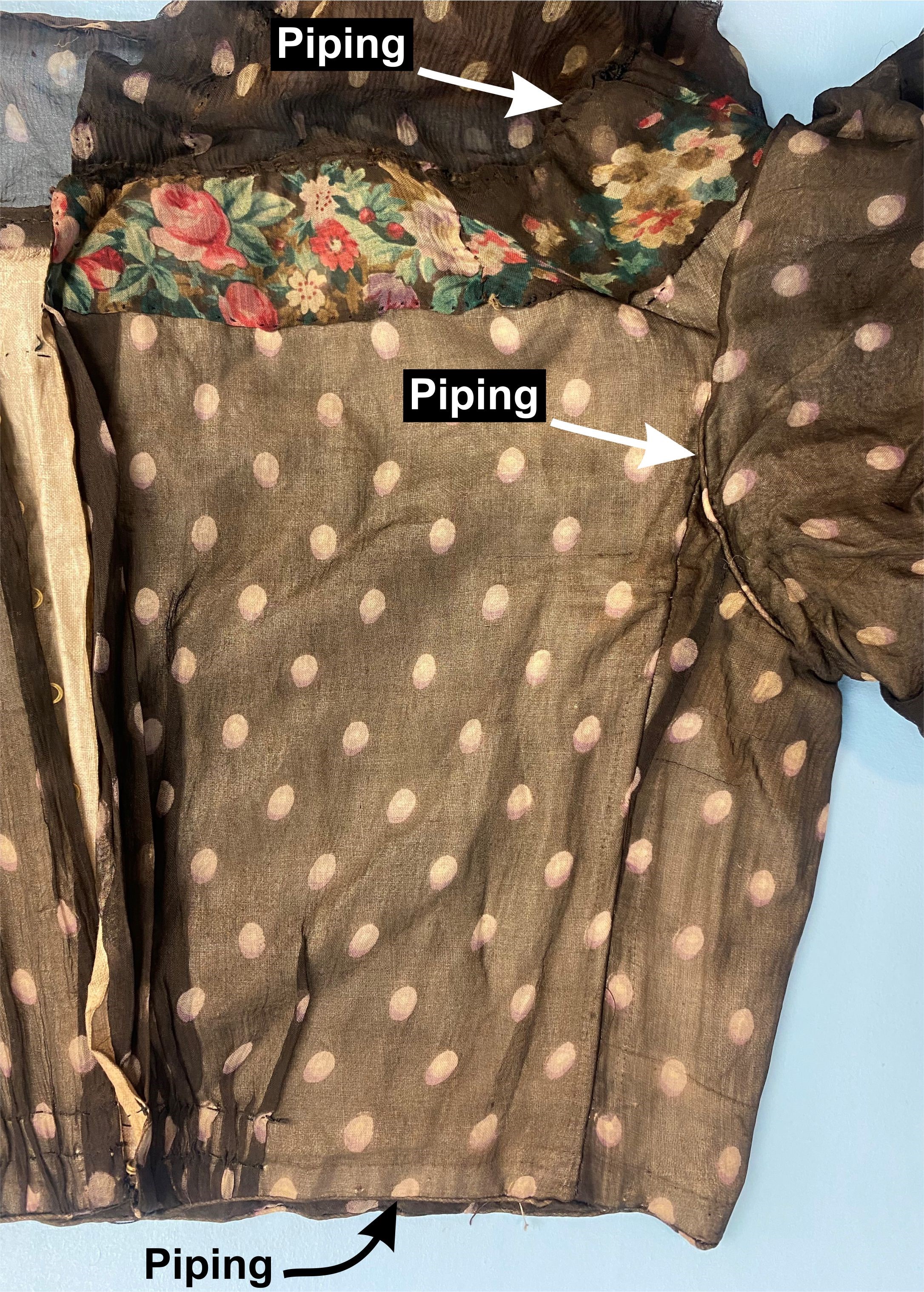
Decorations and embellishments, or lack thereof, were also a consideration in dating the bodice. Based on the research, bodices of this time, less embellishments and decorations than in the previous decade and corresponding border prints were a key element of the 1850s silhouette according to Lydia Edwards on page 100 of How to Read a Dress. Piping was was also found in the sleeves and other areas on the garments of this time, according to several sources; as seen in Figure 3 below.
Figure 3: Piping |
 |
Sewing machines were readily available in the early 1850s; however, they were not common for the average dressmaker or home sewer until later in the century and lock-stitching machines were not created until the mid-1840s. This garment was not sewn with a lock-stitch which indicates that the machine stitching occurred later into the 1850s. Janet Arnold, in Patterns of Fashion, states that machine-sewing did not generally replace hand-sewing until the 1860s, although the first lock-stitch machine was invented by Elias Howe, and patented in Washington, D.C. in 1846, followed in 1851 by Isaac Singer's machine. Again, the outer bodice is primarily hand-sewn and hand stitched to the under bodice. However, the inner bodice is machine-stitched in its entirety.
Based on all these factors, the presumed date of this bodice is between 1854 and 1858. There are several questions that remain unanswered. Could the original printed silk bodice have been part of an earlier garment that was altered into this bodice due to a change in fashion? Or did someone start this at an earlier time then it was completed? The only way to accurately determine this would be to scientifically date the two fabrics and see if there was a substantial difference in their dates. The exact date of the alterations could not be determined.
Bodice Construction
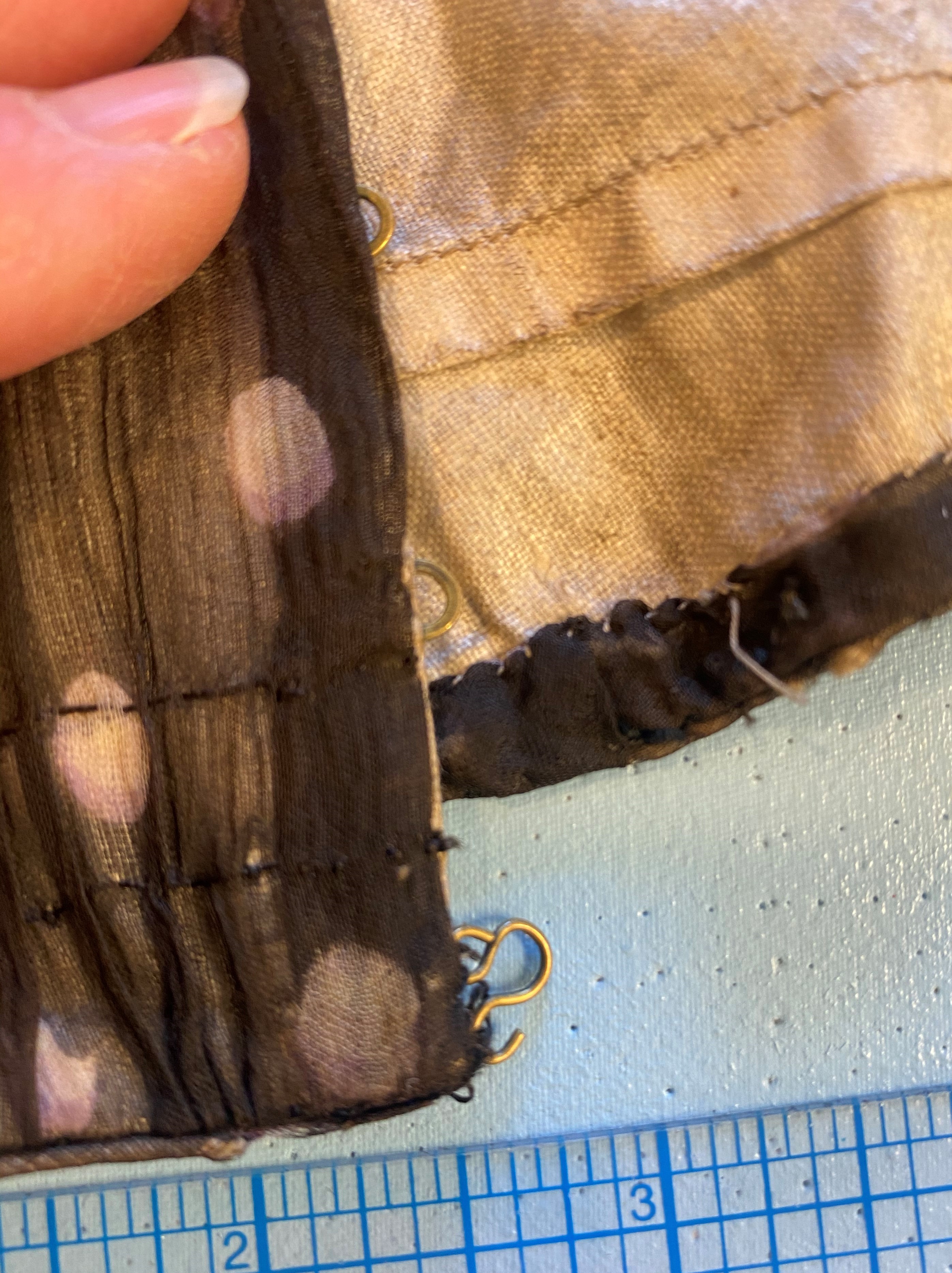
The bodice consists of a boned under bodice, gathered outer bodice with sloping shoulders and long sleeves that are pleated at the shoulder with a sleeve flange. The bodice has eight bones, 11 brass hooks and eyes on the under bodice, and six silver, painted black hooks and eyes on the yoke. The unpainted brass eyes have been flattened in the loop of the eye, except for the eye at the waist. They are also enclosed in the selvedge of the fabric that is folded over the eyes and whip-stitched down hiding the stitching and creating the bone casing at center back. There are no other closures on the bodice.
Detailed Measurements of the Historic Garment
Bust: 28"
Neckline: 12"
Front Nape to Waist: 12"
Center Back nape to Waist: 16"
Armscye: 10 1/4"
Outer Sleeve Seam: 20 1/2"
Inner Sleeve Seam: 13"
Wrist: 13"
Under Bodice
The under bodice was constructed from a coated linen, natural in color. It consists of three pieces. One front piece that extends beyond the side seam location closer to the side back, and it is cut on grain with grain rotation at approximately 45 degrees at the side back seam. The side back seams are slightly tilted towards the center back of the bodice 1 1/2" beyond the natural side seam. At center front there is a bone casing made of a piece of selvedge that is 6 1/2" long. On each side of the center front bone, there is one, almost vertical, 6 1/2" dart, one 6 1/2" dart that is slightly angled towards the bust point, and a third dart which is a horizontal dart beginning at the seam of the second dart terminating in the side back seam. The horizontal dart is located 1 1/4" above the waist seam and is a shallow dart. The vertical darts are machine stitched (except where repairs have been made) and used as bone casings with the excess fabric cut away. In Figure 4 below, note the bone casings, darts, closures, scarring, damage and visible stitching.
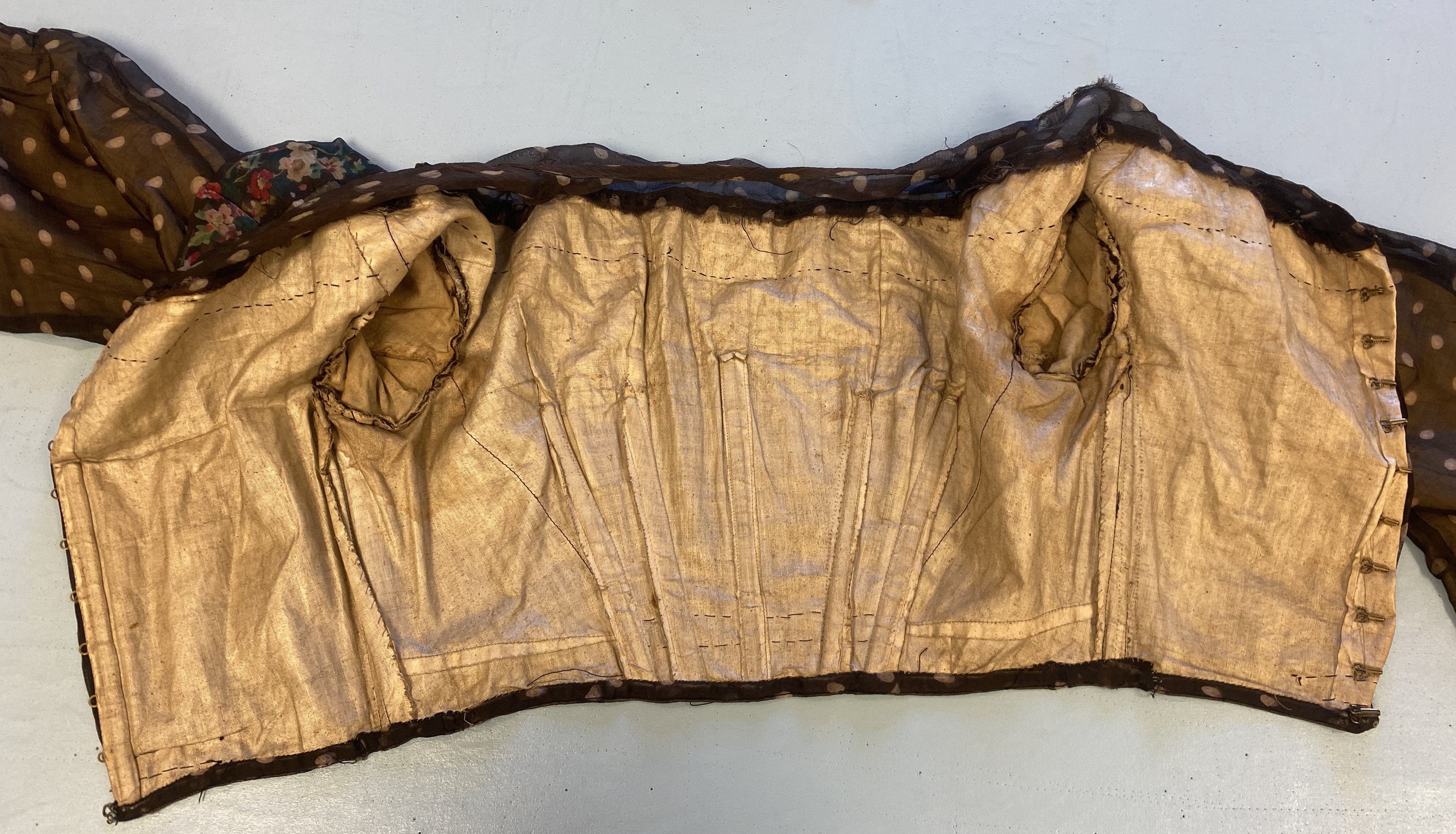
The horizontal darts are machine stitched and do not contain bones. There are two back pieces that close at center back. The two side back seams are stitched by machine to the front piece and have been closed to create bone casings. The bones are 6" in length. One bone at center back is 6 1/2" long, encased in the selvedge edge of the fabric that has been folded to create the casing and cover center back closures. The bone is located on the underlap side of center back, and there is no bone in the overlap side. The shoulder seams are set back approximately 2" from the natural shoulder line. A faux princess seam is machine stitched on the underbodice, which controls the fashion fabric of the outer bodice. Both back pieces are cut on grain using the selvedge edge as a finish on both center back seams. The bones in the underbodice are whale bone and are visible where the stitching has failed. Seam finishes in the inner bodice are whip stitches used at the side back and shoulder seams. The armscye appear to have been finished with a whip stitch or overcast stitch primarily in the armpit area. The upper sleeve does not appear to have been bound or finished. There is no indication that the under-bodice fabric was flat-lined to the outer bodice fabric, apart from the armscye.
Outer Bodice
The fabric is a double thread, plain weave, sheer, crinkled silk chiffon. The design is printed onto the silk, not woven, and has three light colors with a dark gray or faded black matrix color. The dots are irregular ovals with a small white dot in the center, including a light lavender oval shape around the white dot, and a darker lavender eclipse shape on the bottom of the ovals. The ovals are on a 1" grid in a diagonal configuration. If the bodice fabric was originally black and the black has faded over time, the fabric has faded equally over the entire bodice.
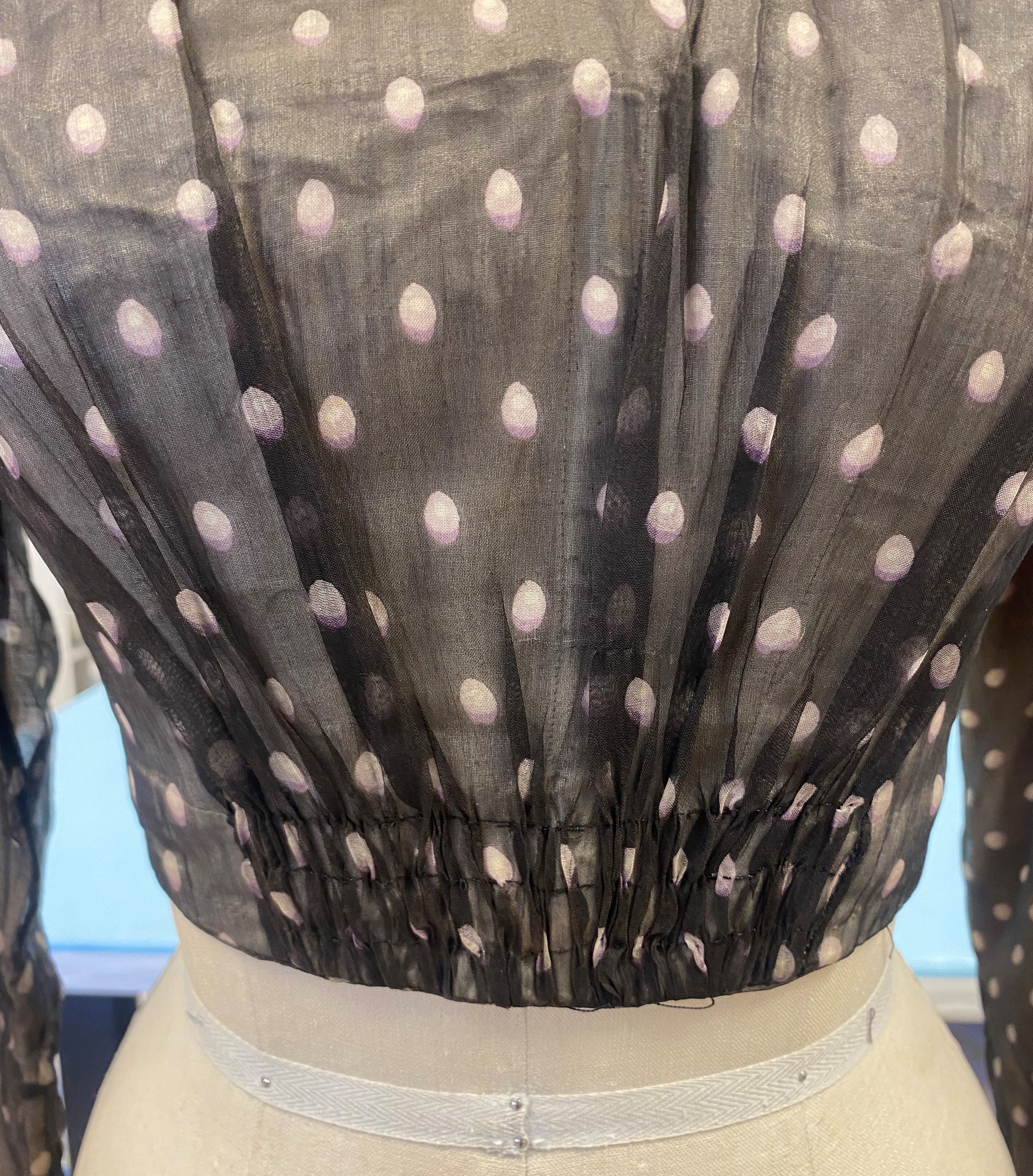
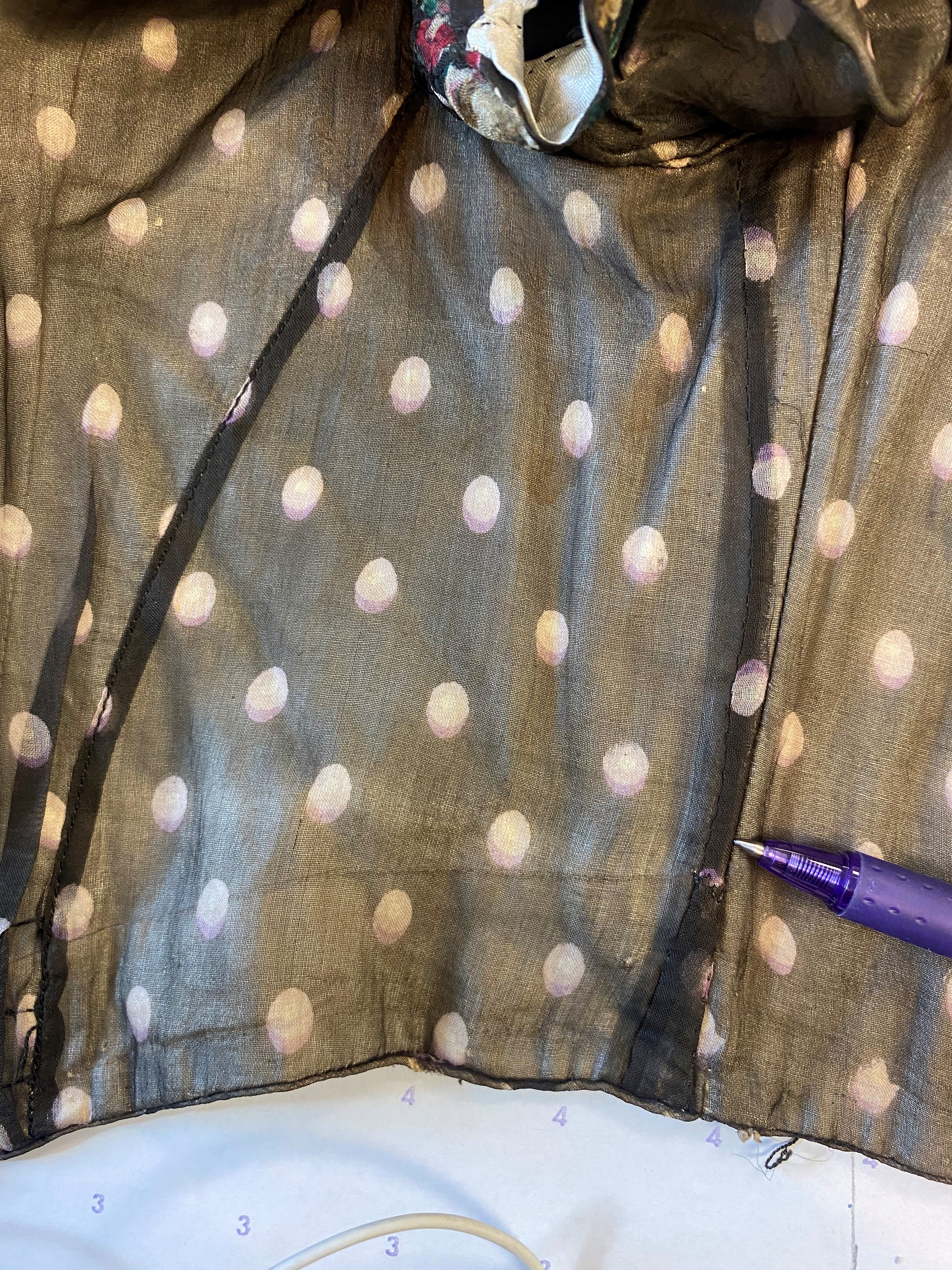
The fashion fabric of the bodice consists of six pieces. The pieces are one front piece, two back pieces, one front yoke piece and two back yoke pieces. There is no side seam, it is shifted to side back approximately 1 1/2" as seen on the under bodice (see Figure 4 above). The chiffon fabric is cut on grain at center front and is not darted. In place of the darts, the front piece was expanded at the waistline, then gathered down to four inches at center front, between what would be the natural princess seams. The fabric is gathered using four gathering stitches approximately 1/2" apart, with one being bound in the piping at the hem and remain intact and visible. The gathering stitches are secured to the underbodice within the gathered fabric. The faux princess seam is tucked on itself 1/16" towards the side back seam and top stitched down, allowing the fabric to be near on grain at the side back seam.
Figure 5: Front Detail:Gathering |
Figure 6: Back Detail:Faux Seaming and Side-back Seam |
 |
 |
The three yoke pieces are one layer of the silk fashion fabric with no lining or netting to support the silk. The yoke is cut on grain at center front and center back. The shoulder seams are not offset to the back as observed on the under-bodice shoulder seams. The shoulder seams are hand stitched and finished together with a slip stitch. The outer bodice fabric is stitched into the under-bodice seam. No flat lining stitching is visible. The neckline is high, is finished with piece of the silk as bias, and it is hand stitched.
The outer silk fabric is gathered to the center front and center back and secured to the under bodice and finished with a 1/32" thread piping/cording. This piping/cording is between the top of the bodice front and back at the yoke seam and in the armscye (see Figure 3 above). There are no existing or any remnant of seam at these seams.
Sleeves
The inner sleeves are constructed of un-coated cotton muslin. The outer sleeve is made of the printed silk in two pieces in the same shape as the under sleeve. The outer seam on the sleeve measures 20 1/2" and the inner seam measures 13”. The right inner sleeve is a one-piece, trapezoidal shape cut on grain and on the fold, that has been darted at the sleeve cap and cuff to create the looseness and shape of the sleeve. A slight curve in the inner sleeve seam is present; however, primary shaping occurs on the outer seam darts. The left sleeve is a two-piece sleeve cut on the cross grain shaped the same as the right sleeve. The sleeves appear to be flat lined together at the sleeve head, have a 1 1/4" box pleat at the cap, three 1/2" pleats to the front, and two 1/2" pleats towards the back, radiating out from the sleeve cap. There appears to be no other gathering of the sleeve into the armscye. A flange of the dark gray printed silk and lined with silver China silk is inserted in the arm eye seam. The flange is shaped, not gathered, or pleated, 5 1/2" wide at the cap and 1 3/4" at the faux front princess seam and is connected to the upper sleeve edge. The flange has the same 1 1/2" floral border that is on the yoke at the edge. The sleeves have no closures at the wrist. The inner and outer fabric at the wrist is turned 1” and hemmed. Then finished with the 1 1/2" floral border top applied to the hemmed inside the lower sleeve edge. The sleeves are entirely hand sewn, appear to be hand-stitched to the bodice, and the seams are not finished on the inner or outer sleeve.
Damage and Alterations
Damage
The under bodice is well preserved. The original color of the linen is unknown; however, the current color is cream/tan consistent with the ageing of the bodice fabric. There is significant staining from perspiration and deterioration of the fabric coating in the underarm area. The coated linen is softer than the currently available coated linen available. There is scarring at the side back seams (see Figure 4 above) where the bodice has been let out and in one of the front darts where the seam was repaired.
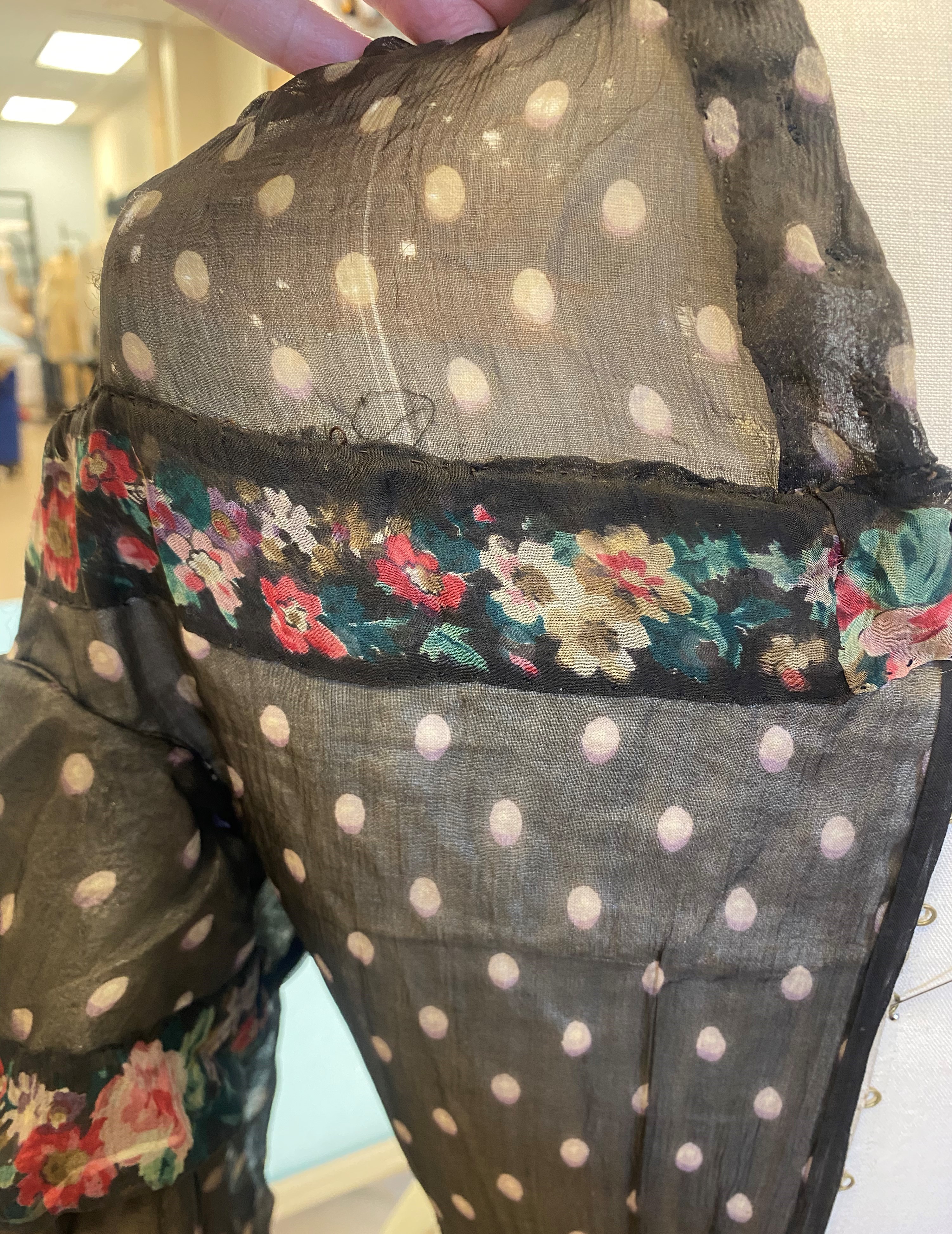
The outer bodice is in good to fair condition for the age and delicate nature of the bodice fabric. The silk fabric over the underbodice shows wear and scarring from alteration like that of the under bodice, with some holes observed. There is visible perspiration staining on the silk similar to the staining observed in the under bodice. The yoke is made of one layer of the silk fabric with no lining or netting to support the silk. There is fracturing of the silk in this area with holes that range from less than 1/16" to 1/4" with a tear near the shoulder seam that is approximately 5/8" long, and a small tear in the neckline. The binding stitching of the neckline has degraded, and the binding can be opened at various points. The main structural seams are all intact; however, the top and slip stitching has disintegrated in various on the bodice. Also, there appeared to have been thread binding in the armscye that has deteriorated or was clipped as part of an alteration.
The border at the sleeve hems have become unstitched and the border fabric is unraveling in some areas. Also, some of the central points in the flowers have disintegrated; however, it is not occurring on all flowers. Overall, the bodice is in good condition, which allowed for extensive inspection.
Figure 7: BackWith Small Holes |
Figure 8: Back WithBorder Alteration |
Figure 9: Closure Detailwith Alteration |
 |
 |
 |
Alterations
The bodice side back seams have been increased 1/4" on each side, and the yoke has been shifted upwards around the entire yoke an average of 1/2" (See Figure 4 above). It also appears the armscye has been increased, possibly as a result of the side seam alteration. Observation under a hand lens revealed residual threads that appear to have been thread binding that have been clipped out.
There are two floral border prints on the bodice that are of slightly different sizes. The bodice yoke borders are made from different prints and and different sizes. The print on the sleeve cuffs is 1 1/2" wide and have a more defined floral pattern. The floral print on the bodice yoke and sleeve flanges are one inch wide with more solid background. The print has blurred edges and the sleeve cuff and piece at center back are a more defined floral print, as can be seen in Figures 7 and 8 above. It is unknown if this was intentional, an addition or alteration, or repair.
The main issue in determining the construction of the bodice was that much of seam stitching is in good condition and or is bound or piped/corded. Also, several of the seam allowances have been reduced to 1/8” to 1/4" or less in width making it impossible to identify specific layers.
© Ellen Cornette, 2022