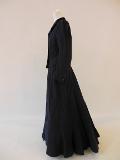
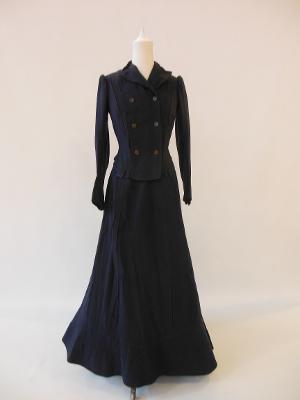
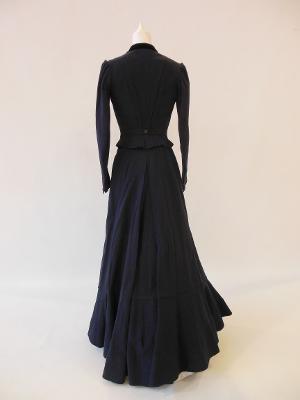
Overview: This navy wool ensemble consists of a jacket and skirt that is decorated with two pleated lines running down both pieces. The skirt has a deep flange at the bottom edge.
Construction: This wool ensemble consists of a deep blue double breasted jacket and a long matching skirt. The jacket is double breasted, with three tortoise-shell buttons on each side. Next to each line of buttons is a pleated section of fabric one inch wide that ends in a flap on the bottom edge. The sleeves are gathered on the shoulders and have two tortoise-shell buttons on the cuff. The lapel of the jacket is wing-shaped and both sides have a button hole. Black cotton velvet is sewn onto the surface of the collar, by hand. The interior is lined with blue silk taffeta that's fractured, and between the silk and wool is a brown canvas, serving as support, around the shoulders, chest, and armholes.
The skirt is the same fabric as the jacket, and has identical pleated segments that align when worn. A 7" wide segment of fabric, a flange, is sewn into the bottom of the skirt. 3.5" of this flange has horizontal stitching that creates 11 lines. The skirt has a brown cotton waistband which is 1.5" wide and closes with a length of cotton. Metal hooks are attached to the interior of the waistband that would have connected to a blouse or bodice. A deep box pleat at center back is held closed with three sets of hooks and eyes which extend about 10" down after which the pleat is released.
Provenance: A label on the collar of the jacket reads "JAMES McCREERY & CO. / NEW YORK." James McCreery & Co. Dry Goods, located at 801 Broadway (Broadway and 10th Street), opened in 1868 and flourished well into the 20th century. The building, which has a cast iron foundation and internal supports, is extant. It was converted into 144 apartments in 1974 after a fire destroyed much of the contents in 1971. It is generally referred to as the Cast Iron Building.
Damage: The lining of the jacket is shattered.
Tags: Has been studied and reproduced by MFA candidate