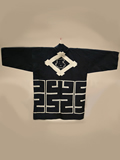

Bernardo, Michael, et al. “Introduction | What Is Kamon?” Japanese Heraldry, 15 Sept. 2017, www.thejapaneseheraldry.com/kamon/.
“Curtain (Noren) in Hemp and Cotton with Tsutsugaki Dip-Dyed in Indigo and Brushed Sumi Ink, from the Meiji Period.” Wikipedia, Wikimedia Foundation, en.wikipedia.org/wiki/Tsutsugaki.
Dalby, Liza Crihfield. Kimono: Fashioning Culture. University of Washington Press, 2001.
“Gifu (Japan).”FOTW "Flags Of The World" Website, fotw.info/flags/jp-21.html.
Gürses, Ahmet, et al. Dyes and Pigments. Springer, 2016, SpringerLink, link.springer.com/chapter/10.1007/978-3-319-33892-7_4#citeas.
“Hachisuka Clan.” The Samurai Archives, wiki.samurai-archives.com/index.php?title=Hachisuka_clan.
“Haori: Japanese 1950 -2000 Black and White Mens Japan Haori [Cotton].” NowesArk, costumes.unc.edu/costar/view/NowesArk/garment.jsp?id=4015.
“Haori with 5 Kamon: Japanese 1900 -1950 Black and White Mens Japan Haori [Silk].” NowesArk, costumes.unc.edu/costar/view/NowesArk/garment.jsp?id=3461.
Mallett, Marla. “Japanese Shibori Haori.” Japanese Shibori Haori, www.marlamallett.com/k-7095.htm.
Nishiura, Kazutaka. “Gifu Prefecture Flag.” Gifu (Japan), 24 Mar. 2015, fotw.info/flags/jp-21.html.
Provax, Alyson. “Different Shibori-Dyed Fabrics.” Seamwork, www.seamwork.com/issues/2015/08/shibori-dyeing.
Speiser, Noémi. The Manual of Braiding. Haupt Verlag, 2018.
Thomson, Anna. “Batik Dyed Fabric.” OiOi Arts, 7 Sept. 2018, www.oioiarts.com/japanese-batik-japan-series/.
Tomoyuki, Yamanobe. “Dyeing Through the Ages.” Japan Quarterly, vol. 13, no. 2, 1 Apr. 1966, pp. 207–213.
“Sumitomo Corporation Logo.” Sumitomo Corporation, www.sumitomocorp.com/en/jp.
“The Emblem (Mon) of the Hachisuka Clan.” Wikipedia, Wikimedia Foundation, en.wikipedia.org/wiki/Hachisuka_clan.
Yamanaka, Norio. The Book of Kimono. Kodansha USA, Inc., 2012.
“120 Years of History 1897 – 1930 | SEI WORLD | Sumitomo Electric Industries, Ltd.” SUMITOMO ELECTRIC, global-sei.com/company/sei-world/2016/11/120years-history.html.
© Ben Silver, 2019