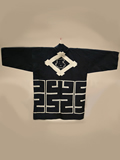

Haori is a type of lightweight outer garment, usually worn over kimono. Originally only worn by men, geisha began wearing haori in the seventeenth and eighteenth centuries, and it quickly developed into a very popular garment for women to wear. Although haori is not as significant in Japanese culture as some other garments, it still has an important place in Japanese dress.
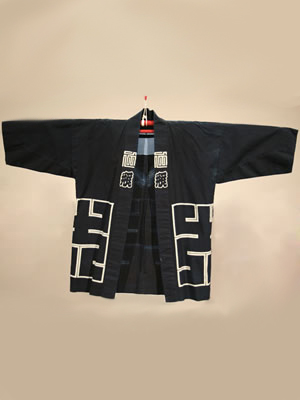
Figure 1: Front |
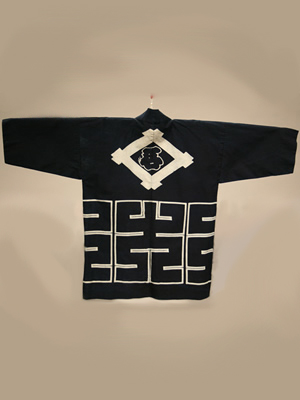
Figure 2: Back |
 |
 |
There are three types of haori worn by people in Japan. The first type is the ceremonial haori, made from silk (commonly black habutae), and worn for formal occasions. It is adorned with five white family crests (kamon) with one on the back side, mid-seam; two on the back of both of the sleeves; and two in front over both sides of the chest. The haori-himo cords for a ceremonial haori are usually white to contrast the black fabric and complement the white family crests.
The second type is the formal haori. Formal haori is made of spun silk or crepe and does not have many patterns or designs on it. Its only decoration is a single family crest on the seam on the back. This haori has to either match the color of the kimono or contrast it by being lighter or darker than the color of the kimono.
The third type of haori is informal haori. Informal haori is usually made out of spun silk, cotton, or wool because these materials are less expensive. This haori is an everyday garment, and is used more for protection than for any cultural or ceremonial reason. Because this haori is informal, it is medium or short, since long haori is only used for formal wear.
The haori that can be seen in Figures 1 and 2 above, is a cotton, dark blue haori with large off-white-beige on it. This haori is an informal haori, which is indicated by many different features. The first, most obvious reason is that it is made from cotton and not silk. Another reason is that this haori is closed with a hook and clasp instead of with haori-himo.
Additionally, the dyeing methods used help show the informality of the haori. The haori is hand dyed and shows imperfections such as spots where the dye leaked or where the resist paste was not applied perfectly. Also, it was sewn together by hand after being dyed, which can be determined by the fact that some of the resist pattern edges do not line up across seams. Although the dyeing job is not perfect and there are some mistakes with pattern alignment, the design of this haori was extremely well conceived. The patterns on the garment were carefully measured and the repeated sections of the resist pattern have the exact same measurements.
Since this haori is informal, it does not have kamon on it. However, it does have patterns that are reminiscent of kamon. The large diamond shape on the top of the back (See Figure 2 above) is remarkably similar to the logo of the Sumitomo Group, a Japanese based electronics and energy company. The Sumitomo Group’s original logo came from a kamon design meaning a water well or a spring. The design that wraps around the bottom of the haori has similar shapes to the rectangular kamon of the Hachisuka clan and the top design on the front of the collar is similar to the Gifu Prefecture in Japan. This kamon, which is the symbol on the Prefecture’s flag, represents peace and harmony.
© Ben Silver, 2019