

Hakama is a form of Japanese trousers, often made from striped silk. They can be bifurcated or not, they are tied at the waist using four different ties (called himo) that are attached to the top sides, and fall to the ankle. Both men and women wear hakama. There are two ties (himo) at the front of the pant and two ties at the back. The himo in the front are longer than the ones in the back; they are wrapped about the body and then tied at the back to secure the hakama to the waist. At the top of the back there is a trapezoidal piece stiffened with cardboard, pasteboard, or wood and covered in fabric that is called a koshi-ita. Underneath the koshi-ita and on the inside of the hakama is the hera, a small plastic toggle that is used to help keep the hakama in place.
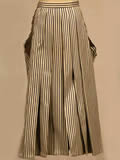
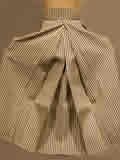
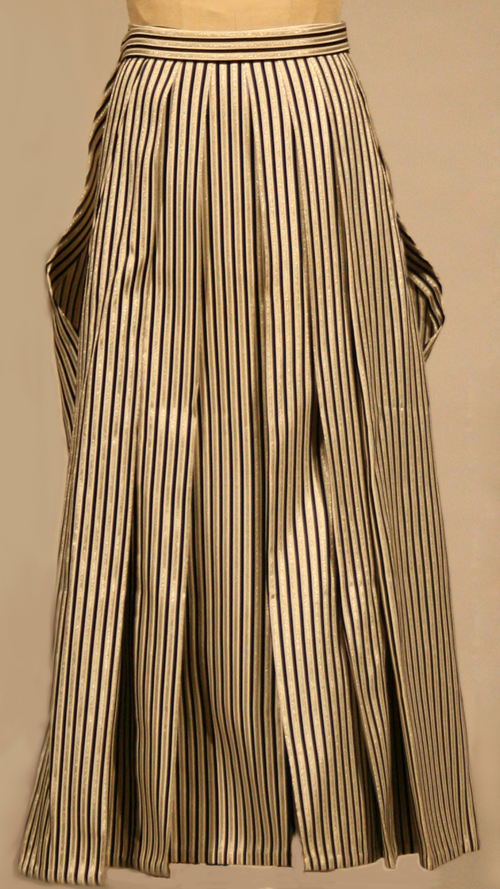
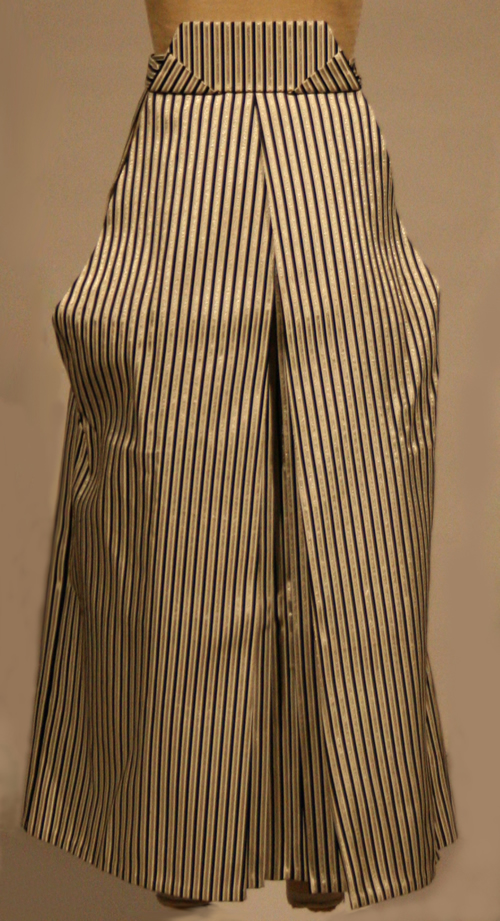
Figures 1 and 2 illustrate hakama made for a man, from very stiff and heavy black and off-white silk with threads of silver interspersed; they measure 70.5 inches long. The waist measures 13 inches across both the front and back panels, but the waist measurement is adjustable with the front and rear attached belts. The front of the hakama has 5 sharply pressed pleats, each of which has a different width, as can be visualized in figure four. The average size of the front pleat, however, was about 5 inches. There were also two sharply pressed pleats in the back of the hakama. The front himo were approximately 105 inches long and the back himo were approximately 50.5 inches long. The side pouches that hang around the waist were approximately 25 inches long. The striped pattern on this article of clothing is fairly standard for most hakamas, as are the colors.
Figure 1: Front |
Figure 2: Back |
 |
 |
The fabric used to make hakama is pleated to control the fullness; each pleat has potentially been assigned a certain value. In Aikido, one of the Japanese martial arts, the pleats are attributed with certain samurai values: jin (goodwill and benevolence), gi (honor and justice), rei (courtesy and manners), chi (wisdom and intelligence), shin (truth and wisdom), chu (loyalty), and ko (devoutness), according to most sources. Although hakama can be used in formal settings in present-day Japan, they are also heavily utilized in many forms of martial arts.
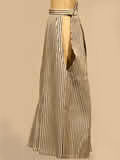
Hakama can be tied in different ways, particularly when it is being utilized in martial arts. Typically, the back of the hakama is a little higher than the front, with the koshi-ita (see Figure 3) sitting at the bottom center in the back. Though there are side slits on the hakama, no skin shows because they are worn over a kimono (or kosode). When stored, the hakama must be folded properly in order for the pleats to be maintained.
Figure 3 shows the koshi-ita in detail. The stiff trapezoid is made of the same fabric as the rest of the garment, wrapped around cardboard. The koshi-ita measures 3 inches tall and 7 inches wide at its base. It is meant to help support the lower back/overall posture. Note that the koshi-ita is attached to the rest of hakama at the bottom edge and has triangular folds on the bottom corners.
Figure 3: Koshi-ita |
 |
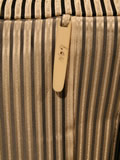
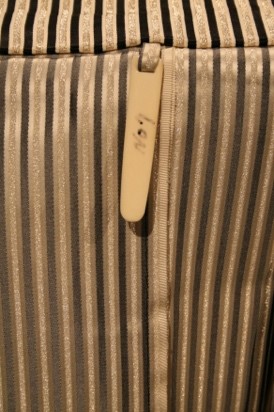
Figure 4 shows the small plastic hera that is on the inside of the hakama centered at the bottom of the koshi-ita. The hera is a smooth, cream, rounded tab about 3 inches long. It has a mark on it that cannot be read.
Figure 4: Hera |
 |
It is likely that these are formal hakama meant to be worm for special occasions. The wearer would not sit astride a horse, engage in combat, or move a lot, indicating that this garment would likely be used for a more ceremonial purpose. Further, the iridescent silver threads in the cloth are highly ornamental. In addition, hakama used for martial arts are made of less stiff and more breathable material such as cotton.
The hakama is a beautiful and versatile garment with deep roots in Japan. Though its uses/presence are not as prolific as it once was, the hakama is still important in many facets of Japanese culture. The hakama is used as formal wear when celebrating or mourning. Formal hakamas can also be used for religious ceremonies, graduations, tea ceremonies, and theater performances. More casual hakamas are utilized in martial arts training due to their airy and movement-allowing structures. Though hakamas are now only found in niche pockets of Japanese culture, the reclamation of traditional Japanese forms of clothing is on a slow upswing, and so is the usage of the hakama.
© Rithi Sridhar, 2017