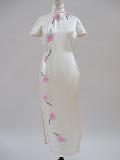

The Mandarin term qipao (旗袍) sometimes referred to as qi pao is known as cheongsam in Cantonese. It refers to a one-piece garment, recognized today as a typical twentieth century Chinese women’s dress. With origins in the Qing Dynasty (1644-1911), the qipao resembles the long, wide, loose robe worn by Manchurian men during that time. Typically made from cotton, wool, or silk, and decorated with lace, embroidery, and beadwork, the qipao is known for its femininity. It uses simple lines, beautiful colors, and detailed ornamentation to accentuate women’s beauty and glamor. Through the years, design and stylistic development of the qipao have become more complex, reflecting Chinese political and cultural aspects as well as Western influences from increasing mass media and global communication. Although the popularity of the qipao fluctuates, the recent reemergence of this garment has contributed to a greater global appreciation for Chinese history and culture.
Figure 1: Qipao Front |
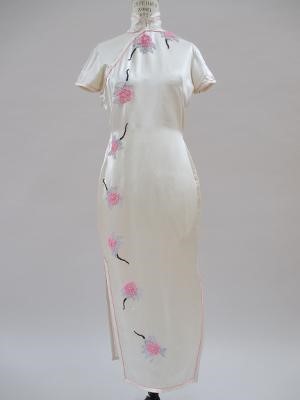 |
When considering the qipao in Figure 1 above, one is able to draw conclusions about the garment through historical context, the color, length, structure, beadwork, and design. This short-sleeved, ankle-length qipao, dating back to the 1960s, is made of ivory silk with a satin finish. It has pink beaded flowers and decorative ornamentation on the edges (called trim) which is visible on the slits, sleeves, and collar. The 2” tall collar, that has removable piece of plastic inside to make it stiff, closes with one hook and seven metal snaps, beginning at the base of the collar and crossing the chest to the right. Eight white and powder blue flowers with pink centers begin at the top left side of the garment and extend all the way down the right side. Each flower is 5" long and 3" wide and is made from glass beads that have been hand stitched to the silk garment. The garment is 50 inches in length and has slits on both sides that extend 16 inches from the bottom. At the narrowest point, the waist measures 13.5" across (27" around), and at the widest point, the hips measure 18.5" across (or 37" around). While some of the hems, including the sleeves and skirt, have been stitched using a sewing machine, the qipao is primarily hand-sewn. For example, the collar has been hand-stitched to the rest of the garment, and the flowers were all beaded by hand. The garment itself is unlined and has had its seams pinked so they do not fray.
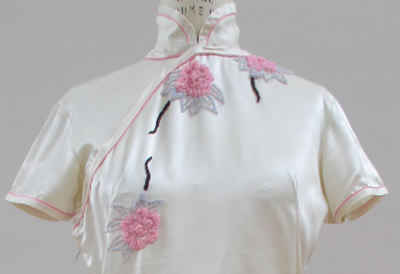
Figure 2: Bodice Detail |
 |
This qipao’s fabric gives off a brilliant luster that shines in the light. Similarly, the thinness of the unlined satiny silk contributes to the garment’s soft and delicate appearance. The pale coloring gives the garment a sense of elegance and purity. It symbolizes serenity and showcases the wearer’s clean character.
The pale blue and pink flowers, which can be seen in Figure 2 above, add a semblance of youth and happiness to the simple garment. They are pink peonies, flowers that are native to Asia. When looking closely, one can see that none of the peonies on the garment were stitched exactly the same. They are also positioned to appear as though they are falling from a peony plant, adding to the garment’s light and delicate feel. The detail involved in the stich work of the glass beads gives the impression that it is a high-quality qipao tailored for a specific woman. Furthermore, the pink trim along the garment accentuates the qipao’s lines and draws one’s eyes to the high slits, contributing to the elegant, yet seductive, nature of the figure-hugging dress. At the time of its construction and use, qipaos were becoming rarer, and even abandoned, during Mao Zedong’s Cultural Revolution in China. This implies that this qipao may have been worn by service workers in the tourism industry. While everyday women in the 1960s were not likely to wear this garment, waitresses, flight attendants, hotel staff, etc. could have worn it in order to emphasize their Chinese heritage for foreign customers or guests, who, at the time, were beginning to consider qipao a stereotypical garment for modern Chinese women.
© Isabelle McGoey, 2019