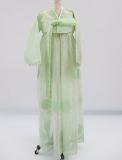

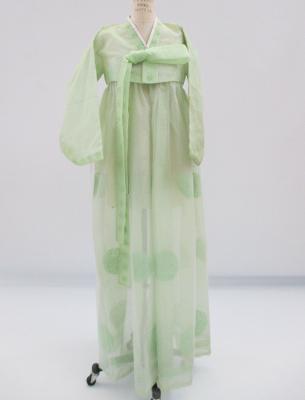
Though it has undergone several transformations over the last 1,600 years, the hanbok has changed little since the Joseon period (1392-1897) which remains the era most influential concerning the hanbok. The hanbok that can be seen in Figures 1 and 2 would be worn for a special occasion.
Figure 1: Front |
Figure 2: Back |
 |
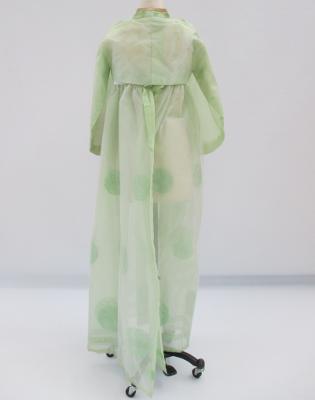 |
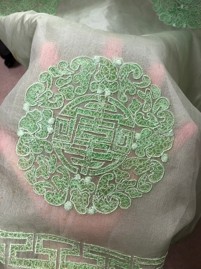
It is made from light green silk organza and consists of a jeogori (jacket) and chima (high-waisted skirt with a sleeveless bodice)). There is also a pair of white cotton trousers that go underneath the sheer chima. The emblems embroidered on, or woven into, a hanbok typically represent nature and are often plants or animals but they can also be geometric patterns or elements of scripture, according to the wearer’s wishes. The pattern on this hanbok (See Figure 3 below) is a geometric version of a Korean decorative element that is surrounded by twinning leaves and flowers. It is a slightly darker green than the garment and has small white flowers.
Figure 3: Woven Pattern |
 |
The jeogori closes in the front, slightly asymmetrically, and has long sleeves that extend beyond the fingertips. The jeogori has a white collar, a tongjong., and is closed with a half-bow, a goreum. This modern jegori has a snap under the tie to help keep it closed. Sometimes the tongjong is a separate piece temporarily attached to the collar but in this case it is sewn in place making it permanent.
The chima, a high waisted flowing skirt, has a short bodice with shoulder straps that help maintain the proper length. A petticoat with a full skirt is often worn under the chima.
© Betsy Scarisbrick, 2019