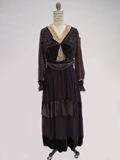

1913 Dress
The eggplant colored dress is made of velvet and chiffon. It is trimmed with lace and beads. An elegant example of fashion from c.1913, the dress was most likely worn for formal occasions. The delicate had-done French seams indicate that the dress was made at home, though machine-finished seams at the neckline and sleeve ruffle may contradict this. The finishes may have been applied later. Certain alteration techniques prove the dress was used for theatrical purposes. Unfortunately, these alterations did little to preserve the integrity of the dress.
Overview
The dress consists of a blouse, skirt, belt and bolero. The blouse and skirt portions are based on a 1-1/2” strip of grosgrain that measures 29” (not including 1” extension for closure). The blouse, bolero, and lining open at centerfront and the skirt and belt open from side front to side front. The skirt further opens 12”down side front seam.
The chiffon blouse gathers in at the waist. It is trimmed with a lace collar and lace front panel. The chiffon sleeves gather at the top of the cap. The sleeves also gather into a velvet band trimmed with a beaded button. A chiffon ruffle gathers into the bottom of the band. The velvet bolero attaches to the waist and the fullness arranged in pleats. The front and back feature a geometric beaded design as does the belt. The belt is also trimmed with two beaded buttons at each side seam. The chiffon skirt gathers at the waist. Two velvet bands trim the skirt.
Bolero
The bolero consists of two pieces for each side front and one piece for the back. Front and back pleat in at the waist, the pleats falling mostly towards centers. The front has a diagonal seam at the bosom to add shape. A pleat falls from this seam. The edges of the bolero are folded under and catch-stitched. Later hem tape was used, but it does not cover the raw edges. A small portion of silk proves the bolero was fully lined. The absence of a lining reveals the beading technique. A pattern was marked on organza that was then secured to the under side of the velvet. Beads were then strung on thread, small portion at a time and secured to the velvet. The beads are white glass beads painted purple.
Belt
The belt was decorated in the same manner. The belt, a 5” wide piece of bias velvet, gathers down to 3-1/2” at the sides. Gathers are controlled by tapes and bones at the sides and front add structure. The beaded décor was applied separately. Its lack of symmetry is confusing. Two 1” beaded buttons are applied to each side seam. The belt is secured to the dress at the waist. It opens from side front to side front and closes with snaps.
Blouse
The neckline of the bodice is decorated with a small decorative machine stitch. The stitched edge is rolled ¼” to the outside and hand-stitched down to the lining. The flat falling lace collar is also secured between these layers. The lace collar measures 4” wide. The corners of the collar myter, a diagonal seam reaches from the corners of the shoulder and neck intersection. Two and three-quarter inches of bobbinet lace is secured to 5/8” fillet insertion lace attached to 5/8” Van Dyke edging lace. The collar is further secured to a 3” piece of bobbinet which attaches to the blouse 3” in from center front and is sewn into the shoulder seam. On top of the bobbinet is a layer of organza. The organza is stitched to the bodice together with the bobbinet. The two layers are further connected by slip-stitching at the centerfront edge. The centerfront edge of the organza is decorated with ½” wide lace. The organza’s raw edges is turned under once about 1/4” and stitched, the other layers are also finished in this method. Embroidered bobbinet is layered on top. It gathers in at the shoulders seam. The raw edge is pinked ½” and unlike the under layers that fit into a seam, this lace is basted on top of the chiffon blouse. The centerfront edges of the bobbinet are trimmed with the same lace as the collar. Three snaps are sewn through all these layers. This modern alteration causes the front to be asymmetrical, destroying the natural fall of the lace.
The fullness of the blouse is controlled by uneven pleats at centerback waist and at the side front. The replacement lining pulls the fullness into two darts. There is a layer of bobbinet between the chiffon and lining. This is found only in the front, not in the back. The centerfront of the lining has three snaps.
Little remains of the original cream China silk lining. It is reinforced by nylon or marquisette. The original lining may have been cut lower than its replacement. Perhaps, in an effort to mimic the older techniques, all alterations were stitched by hand unfortunately, neither the craft nor the quality of replacement fabrics can compare. The original seams are all beautiful hand-sewn French seams.
The sleeves are gathered at the top of the cap and unevenly at the wrist. Most of the wrist gathers are at the opening near the back quarter. The sleeves fall longer and fuller towards the back. At the wrist they connect to a 1-1/2” velvet band that measures 7-1/2” and has a point that extends an inch further. Between the open edges of the cuff is 2” of gathered chiffon piped with hem tape. Elastic is catch-stitched in. The cuffs are secured with a small snap and hook and eye. A 1” beaded decorative button decorated the wrist. The velvet band is bagged out with chiffon. A chiffon ruffle that measures 2-1/2” at the back quarter and 1-1/2” at the front quarter gathers slightly at the back quarter and is catch-stitched to the velvet cuff. The ruffle has one machine-stitched French seam, and the raw edge is also machine-finished. It does not seem to match the theatrical alterations, or the original construction of the dress, perhaps it was added later. There is no evidence of an original lining for the sleeves, but a modern one exists. The lining lacks some of the fullness of the outer sleeve.
Skirt
The skirt consists of three rectangular chiffon panels that gather at the waist. There are two larger panels from each side seam to center back and a smaller panel across the front. All seams are French seams. Part of the original hem does exist. It is a proper hem stitched wit ha running stitch. At the back, a modern alteration binds the raw edges with hem tape and then it is stitched up wit ha running stitch. The acetate lining for the skirt consists of three panels which ease in at the waist. It is not cut as full as the skirt.
Two bands of bias cut velvet trim the skirt - one at the hem and another about 15” down from the waist. These are attached wit ha catch-stitch, therefore most likely a modern alteration. The bands are hemmed with the raw edge turned up and catch-stitched, also probably a modern alteration. It is interesting that he velvet bands are cut on opposing naps. At first glance it seemed to be a careless alteration, but further inspection showed that the top and bottom portions of the bolero and cuffs were cut on different naps. The choice to cut pieces differently might have been deliberate.
Reproduction
Mauve silk chiffon and charmeuse were used to construct this dress. It is lined in China silk. A majority of the pattern was recreated accurately to a degree. It strayed slightly to accommodate a larger figure and different fabric choices. The sleeves of the blouse where cut with an underarm seam as opposed to one at the front quarter. It was decided that a front seam would seem awkward to a modern eye, as this dress might be worn for a special occasion. Hiding the seam at the underarm did not alter the fall or drape of the sleeve. The vest front is cut in one piece as the diagonal seam across the bosom was more visible in the pale charmeuse than in the darker velvet, where the seam was lost in the pile and under the beading. The bolero’s fullness was controlled by gathers at the side back and three pleats at the side front. The fullness of the blouse was controlled by gathers at the side front and centerback waist. The fullness of the skirt was slightly more concentrated towards the back to better flatter a fuller figure. Finding an embroidered piece of bobbinet and period lace proved to be difficult. Plain bobbinet was used. Beading lace took the place fillet lace and two edging laces were used, both with the floral motifs. The beading lace was further enhanced by securing silk ribbon underneath and a small off-white pearl stitched between each opening. This made the beading lace a little more delicate and the lace trim very successful. All lace trim was dyed off-white. Engraved mother-of-pearl buttons replaced the heavier beaded buttons.
© Denise Wagner, 2000